

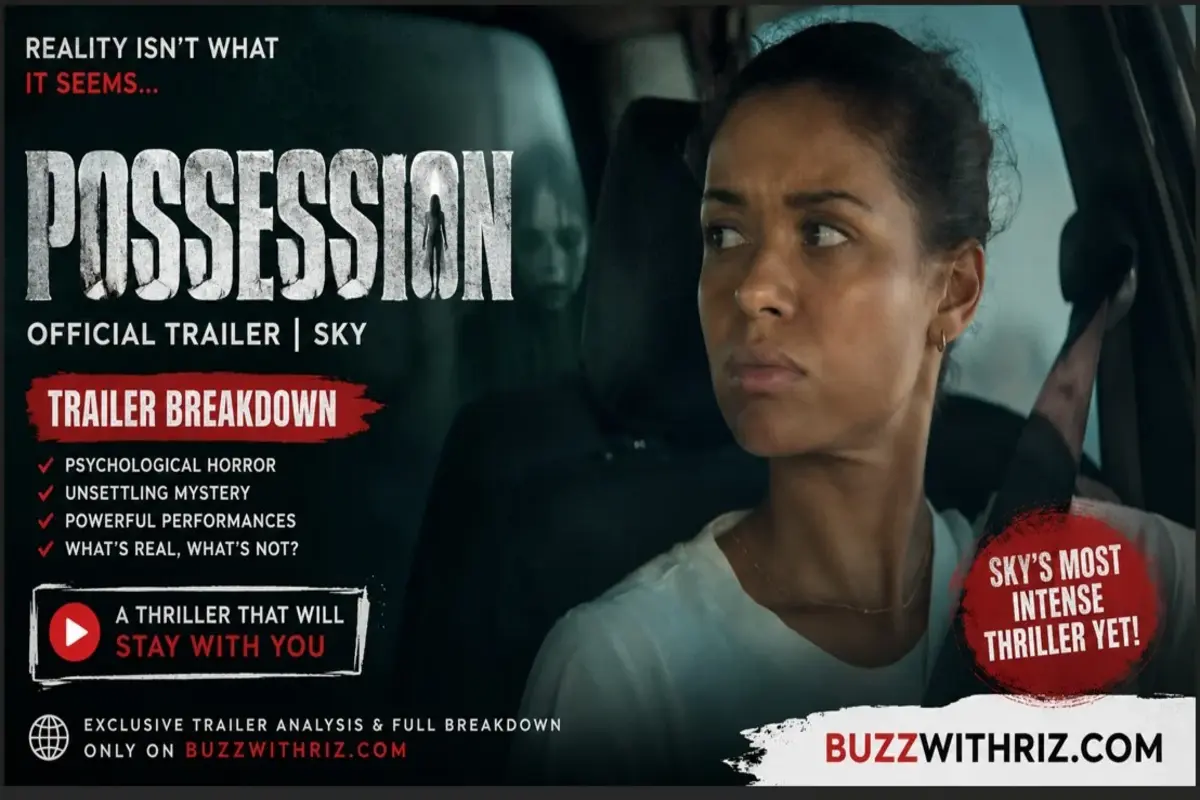
Psychological horror has a unique way of staying with audiences long after the credits roll. Instead of relying solely on jump scares or graphic violence, the genre thrives on uncertainty, emotional conflict, and the terrifying possibility that the greatest threat may exist within the human mind itself. Sky’s upcoming thriller Possession appears ready to embrace that philosophy.
The newly released Official Trailer immediately establishes an atmosphere of unease. Every frame feels deliberate, from quiet conversations and isolated landscapes to tense close-ups that hint at secrets waiting beneath the surface. Rather than revealing too much, the trailer carefully builds suspense, inviting viewers to question what is real, who can be trusted, and whether the central mystery has a supernatural explanation or something far more disturbing.
In an era where audiences increasingly appreciate slow-burning psychological thrillers alongside traditional horror films, Possession positions itself as a compelling addition to Sky’s growing collection of premium original productions. Its restrained storytelling, cinematic visuals, and emotionally grounded performances suggest that this won’t simply be another haunted-house tale. Instead, it appears to explore fear through relationships, trauma, isolation, and perception.
This detailed analysis examines everything revealed in the official trailer, the themes driving the narrative, early story predictions, and why Possession could become one of the year’s most talked-about psychological horror releases.
A Trailer That Builds Fear Through Atmosphere
One of the trailer’s greatest strengths is its confidence in subtle storytelling. Instead of overwhelming viewers with rapid editing or constant scares, the footage unfolds with measured pacing. Silence becomes just as important as dialogue, while lingering camera shots encourage audiences to search every corner of the screen for hidden clues.
From the opening moments, viewers are introduced to a protagonist who appears emotionally exhausted. Her facial expressions communicate anxiety before a single major event unfolds, immediately creating empathy while also raising questions about her circumstances.
The cinematography reinforces this emotional state. Wide, isolated landscapes contrast with confined interiors, creating a visual language that suggests emotional imprisonment despite physical freedom. Natural lighting gradually gives way to darker, colder tones as the trailer progresses, subtly reflecting the character’s deteriorating mental and emotional condition.
This careful visual progression demonstrates a mature understanding of psychological horror. Rather than telling audiences they should feel afraid, the trailer allows tension to develop naturally.
Psychological Horror Over Traditional Supernatural Terror
While the title Possession naturally invites comparisons with classic supernatural horror films, the trailer deliberately avoids confirming exactly what kind of story viewers are about to experience.
Several moments suggest paranormal influences, yet every disturbing event could equally be interpreted through a psychological lens. That ambiguity is one of the trailer’s most compelling qualities.
Instead of presenting obvious monsters or supernatural entities, the narrative appears focused on uncertainty.
Questions begin to emerge almost immediately:
- Is someone truly possessed?
- Are traumatic memories influencing reality?
- Is grief reshaping perception?
- Can every frightening moment be explained logically?
- Or is something genuinely evil beginning to emerge?
These unanswered questions become the trailer’s greatest storytelling weapon.
Modern audiences have shown increasing appreciation for films that refuse to provide simple answers, and Possession appears to follow that tradition by encouraging viewers to interpret events rather than simply witness them.
Emotional Storytelling Takes Center Stage
Another aspect that separates the trailer from many contemporary horror releases is its emotional focus.
Rather than introducing characters simply to place them in dangerous situations, the trailer spends considerable time establishing relationships, vulnerability, and personal conflict.
The lead character appears burdened by emotional trauma long before the supernatural mystery begins to unfold. Her cautious behavior, restrained dialogue, and visible anxiety suggest someone already struggling before unexplained events escalate.
This emotional foundation is essential because effective horror depends on audience investment. Fear becomes significantly more impactful when viewers genuinely care about the people experiencing it.
Sky appears to understand this principle remarkably well.
Instead of rushing toward shocking moments, the trailer encourages viewers to become emotionally connected with its protagonist first, allowing later scenes of uncertainty to carry greater psychological weight.
Cinematography That Amplifies Every Moment
Visually, Possession demonstrates impressive confidence.
Muted color palettes dominate the trailer, creating an atmosphere that feels grounded in reality while gradually drifting toward something darker.
Several filmmaking techniques immediately stand out:
- Long uninterrupted camera movements
- Naturalistic performances
- Minimal visual effects
- Carefully framed close-ups
- Environmental storytelling
- Low-key lighting
- Slow-building suspense
- Symbolic visual composition
These creative decisions suggest a production interested in immersive storytelling rather than spectacle.
The camera frequently lingers on facial expressions instead of action sequences, emphasizing internal conflict over external chaos. Meanwhile, the surrounding environments often appear strangely empty, increasing the feeling of isolation without requiring elaborate horror imagery.
Every frame appears designed to make viewers uncomfortable through suggestion rather than explicit revelation.
Sound Design Creates Invisible Horror
Perhaps the trailer’s most effective element isn’t something viewers see it’s what they hear.
Sound design plays an extraordinary role throughout the preview.
Instead of relying on loud orchestral cues or exaggerated horror effects, the trailer incorporates restrained ambient sounds, subtle musical layers, distant echoes, and carefully timed silence.
These audio choices significantly increase tension because they encourage audiences to anticipate danger before anything actually happens.
Moments of near silence often become more frightening than scenes filled with dramatic music.
This minimalist approach reflects confidence from both the filmmakers and the sound department, indicating that Possession aims to unsettle viewers psychologically rather than overwhelm them with constant sensory stimulation.
Themes That Could Define the Film
Although only a few minutes long, the trailer introduces several themes that seem central to the story.
Fear of Losing Control
The title itself immediately evokes the fear of surrendering control over one’s own mind or body.
Throughout the trailer, the protagonist appears increasingly uncertain about what she is experiencing. Her hesitation, confusion, and emotional exhaustion suggest that the greatest horror may not be an external force but the possibility of losing trust in herself.
This internal conflict often creates more lasting suspense than traditional horror because it speaks to universal human fears.
Isolation
Nearly every location shown in the trailer reinforces emotional and physical isolation.
Whether inside a vehicle, an empty house, or wide open landscapes, the lead character often appears alone. Even when other people are present, the emotional distance between them remains striking.
Isolation has always been one of psychological horror’s strongest storytelling tools, allowing fear to grow without immediate reassurance or support.
Sky appears to use this technique effectively, making ordinary locations feel increasingly threatening simply because they lack safety and comfort.
Trauma and Memory
Another compelling possibility is that the story explores unresolved emotional trauma.
Rather than introducing evil without explanation, the trailer hints that past experiences may influence present events.
This layered approach allows horror to function on two levels:
- External suspense created through mysterious occurrences.
- Internal conflict driven by emotional wounds.
When these two elements intersect, psychological thrillers often become far more memorable than straightforward supernatural stories.
Visual Storytelling That Speaks Without Dialogue
Some of the trailer’s strongest moments contain very little dialogue.
Instead, meaning is communicated through composition, lighting, facial expressions, and deliberate camera placement.
Close-up shots capture subtle emotional reactions, allowing audiences to observe fear before characters openly acknowledge it.
Wide shots frequently position the protagonist against large, empty environments, visually reinforcing vulnerability.
Dark interiors contrast sharply with natural daylight, suggesting a gradual movement from normality toward uncertainty.
Even everyday settings become unsettling because of careful framing rather than exaggerated horror imagery.
This restrained filmmaking style reflects confidence in visual storytelling instead of relying on excessive exposition.
Performance Expectations
Although the trailer reveals only selected scenes, the performances appear grounded and emotionally authentic.
The lead actor carries much of the trailer’s emotional weight through restrained expressions rather than dramatic outbursts.
Instead of exaggerated fear, viewers witness believable anxiety, confusion, and emotional fatigue.
Supporting characters contribute to the growing uncertainty by offering limited information, making every interaction feel significant.
If these performances maintain the same consistency throughout the film, audiences can expect a character-driven thriller where emotional realism enhances every frightening moment.
Strong performances are particularly important in psychological horror because the audience must believe the characters’ emotional experiences before accepting the larger mystery.
Direction That Prioritizes Suspense Over Spectacle
Modern horror often relies on rapid editing and constant jump scares.
Possession appears to move in the opposite direction.
The trailer demonstrates patience.
Scenes are allowed to breathe.
Camera movements remain controlled.
Editing avoids unnecessary chaos.
Music supports tension rather than overpowering it.
This measured pacing suggests that the director is more interested in sustained suspense than short-lived shocks.
The result is a trailer that lingers in the viewer’s mind after it ends a hallmark of effective psychological filmmaking.
Why This Trailer Stands Out
Hundreds of horror trailers are released each year, yet relatively few create genuine curiosity without revealing major plot twists.
Possession succeeds because it understands that mystery is one of horror’s greatest strengths.
Instead of answering questions, it creates new ones.
Rather than introducing obvious villains, it focuses on emotional instability.
Instead of emphasizing visual effects, it builds atmosphere.
This approach immediately distinguishes the film from more conventional genre releases.
Viewers leave the trailer wanting answers instead of feeling they’ve already seen the entire movie.
That balance between revelation and restraint is increasingly rare in modern marketing.
Early Audience Expectations
Based solely on the official trailer, several expectations emerge.
Audiences looking for relentless action or nonstop jump scares may find the film more restrained than anticipated.
However, viewers who appreciate intelligent psychological thrillers are likely to be drawn to its deliberate pacing and emotionally driven storytelling.
The trailer suggests a film that rewards patience, careful observation, and emotional investment.
If the final release maintains this level of craftsmanship, Possession has the potential to resonate with fans of atmospheric horror that values character development as much as suspense.
Final Thoughts
Sky’s Possession immediately establishes itself as more than a conventional horror release. The official trailer showcases careful filmmaking, emotionally grounded performances, and a restrained approach to suspense that prioritizes atmosphere over spectacle.
Rather than revealing every twist, the trailer invites audiences to question what they see, encouraging theories about memory, trauma, perception, and the possibility of supernatural influence. This sense of uncertainty is exactly what gives psychological horror its lasting impact.
If the complete film maintains the same level of narrative discipline and visual craftsmanship seen in the trailer, Possession has the potential to become one of Sky’s most compelling original thrillers. For horror fans seeking tension built through emotion, mystery, and psychological depth, this is undoubtedly a title worth following.
SOURCE: Sky Television, IMDB, Wikipedia
Keep in Touch For More Updates: www.buzzwithriz.com

2 Comments
Pingback: WICKER Official UK Trailer Breakdown and Review
Pingback: Barreda Official Trailer | Prime Video True Crime Drama