

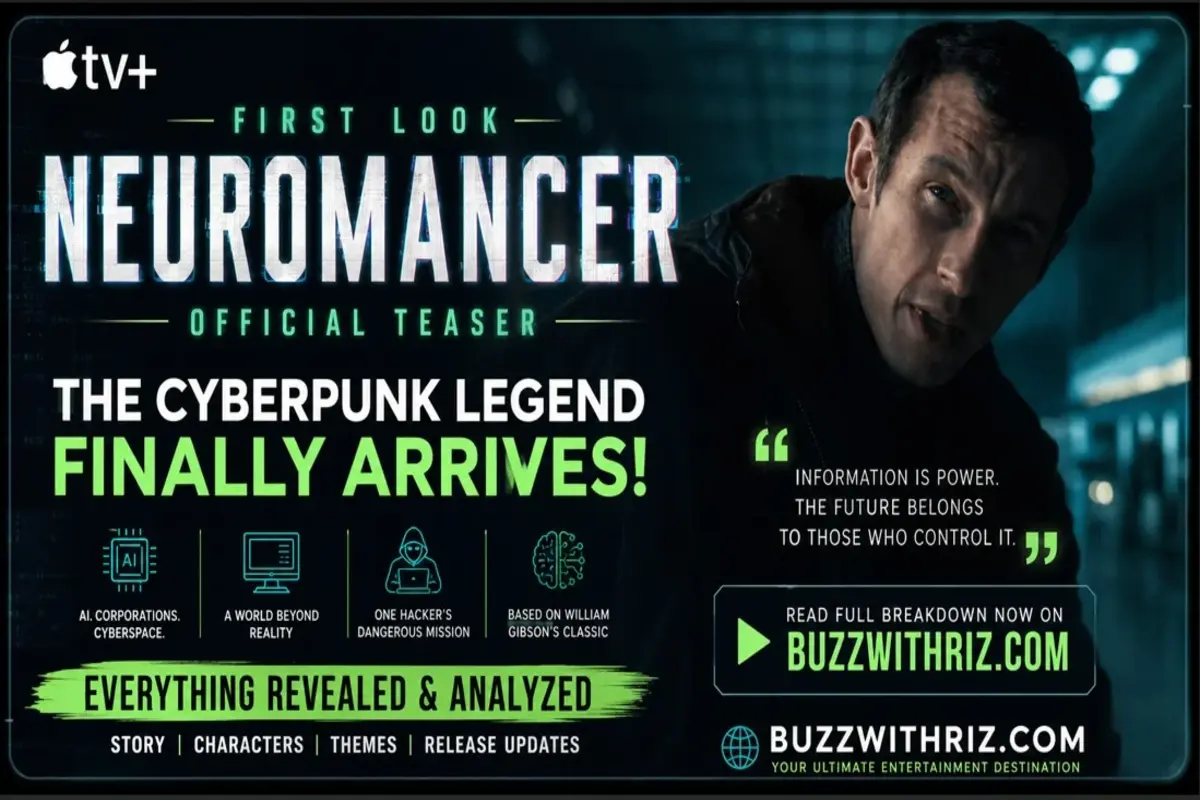
Few novels have transformed science fiction as profoundly as William Gibson’s Neuromancer. Published in 1984, the novel didn’t simply introduce readers to futuristic technology it reshaped the way the world imagined cyberspace, artificial intelligence, digital crime, and humanity’s increasingly complicated relationship with machines.
For decades, Hollywood struggled to adapt Gibson’s visionary work. Numerous filmmakers attempted to bring the legendary novel to life, yet every effort stalled before reaching audiences. That long journey has finally reached its most promising chapter.
Apple TV+ has released the official teaser for Neuromancer, offering viewers their first glimpse into a neon-soaked world filled with elite hackers, powerful corporations, artificial intelligence, and digital realities where information has become the world’s most valuable currency.
Although the teaser intentionally keeps many story details under wraps, it successfully establishes the atmosphere that made Gibson’s novel a cultural landmark. Rather than relying on explosive action sequences, Apple appears focused on mood, tension, and immersive world-building a promising creative direction that respects the source material while embracing modern television storytelling.
For longtime readers, the teaser feels like a long-awaited celebration. For newcomers, it introduces a universe that has inspired countless films, television shows, and video games over the last four decades.
In this detailed analysis, we’ll examine what the teaser reveals, how faithfully it reflects Gibson’s original vision, why Neuromancer remains relevant in today’s AI-driven world, and what audiences should expect when Apple TV+ finally opens the doors to one of science fiction’s most influential universes.
A Cyberpunk Classic Finally Arrives
Before discussing the teaser itself, it’s impossible to overlook the enormous significance of this adaptation.
When Neuromancer debuted, the internet barely existed in everyday life. Smartphones were unimaginable, social media hadn’t been invented, and artificial intelligence belonged mostly to speculative fiction. Yet Gibson described a connected digital universe so convincingly that many of today’s technological concepts seem remarkably similar to his fictional predictions.
His vision introduced readers to ideas including:
- Virtual reality navigation
- Artificial intelligence governance
- Mega-corporate influence
- Digital identity
- Information warfare
- Cybercrime
- Neural interfaces
- Hackers operating inside virtual networks
These concepts eventually became foundational elements of modern cyberpunk storytelling.
Without Neuromancer, it’s difficult to imagine later cultural phenomena like The Matrix, Ghost in the Shell, Cyberpunk 2077, or numerous futuristic television dramas. Gibson’s influence extends far beyond literature, making this Apple TV+ adaptation one of the most anticipated science-fiction projects currently in development.
The teaser recognizes this legacy by avoiding unnecessary exposition. Instead, it invites viewers into a world that already feels technologically alive, emotionally distant, and visually mesmerizing.
First Impressions of the Official Teaser
Apple’s teaser immediately establishes a distinct identity.
Rather than overwhelming audiences with rapid editing and oversized action sequences, the preview embraces restraint. Slow camera movement, carefully composed lighting, industrial environments, futuristic architecture, and subtle electronic sound design create a sense of mystery from the opening moments.
The atmosphere suggests a future where technology isn’t simply advanced it’s become inseparable from everyday existence.
Every frame appears intentionally designed to communicate isolation.
Characters rarely appear comfortable within their surroundings. Vast interiors, dimly lit corridors, metallic environments, and sterile corporate spaces emphasize a society shaped more by systems than by people.
This visual language aligns closely with Gibson’s original themes.
Cyberpunk has always explored the contrast between extraordinary technological progress and deeply flawed human societies. Advanced innovation doesn’t necessarily produce happier lives. Instead, technology often amplifies inequality, corporate control, surveillance, and existential uncertainty.
Apple’s teaser seems determined to preserve these philosophical foundations rather than transforming Neuromancer into a conventional action spectacle.
That creative decision alone makes the adaptation particularly exciting.
The World Feels Authentic Instead of Artificial
One of the teaser’s greatest strengths is its production design.
Instead of presenting a polished futuristic utopia, the environments feel lived-in.
Industrial textures, muted lighting, weathered architecture, and practical locations suggest decades of technological evolution rather than freshly constructed science-fiction sets.
This authenticity matters because Gibson’s universe has always emphasized realism beneath its futuristic concepts.
Technology isn’t presented as magical.
It’s ordinary.
People depend on it.
Corporations monetize it.
Criminals exploit it.
Governments struggle to control it.
That philosophy separates Neuromancer from many modern science-fiction productions, where futuristic gadgets often exist primarily for spectacle.
Apple appears committed to portraying technology as infrastructure rather than visual decoration.
That subtle distinction could become one of the series’ greatest creative strengths.
A Story That Has Become More Relevant Than Ever
Perhaps the most fascinating aspect of the teaser is its timing.
When Gibson imagined cyberspace in the early 1980s, few could predict how dramatically technology would reshape everyday life.
Today, conversations surrounding artificial intelligence, cybersecurity, digital privacy, online identities, cryptocurrency, neural computing, machine learning, and corporate data collection dominate headlines worldwide.
Many of these debates echo ideas explored in Neuromancer decades ago.
This makes Apple’s adaptation particularly timely.
Instead of feeling like nostalgic science fiction, the story now reflects genuine contemporary concerns.
Questions such as:
- Who controls information?
- Can artificial intelligence outgrow human oversight?
- What happens when corporations become more powerful than governments?
- How much of ourselves exists online?
- Is technology liberating humanity or quietly controlling it?
These themes resonate more strongly today than they ever have before.
As audiences increasingly seek science fiction that explores meaningful ethical questions rather than simple action, Neuromancer arrives at precisely the right cultural moment.
A World Governed by Corporations Instead of Governments
One of the defining characteristics of Neuromancer is its vision of corporate dominance.
Traditional governments exist, but the true centers of power belong to multinational corporations controlling technology, finance, artificial intelligence, and information.
The teaser subtly reinforces this hierarchy through sleek facilities, imposing architecture, and environments that feel engineered rather than lived in.
This isn’t merely background design.
It’s a visual representation of one of Gibson’s central themes:
Technology creates opportunity but concentrated power determines who benefits.
Today’s audiences may recognize striking similarities between this fictional future and real-world conversations surrounding global technology companies, data privacy, surveillance, and artificial intelligence.
Rather than feeling outdated, Neuromancer now appears remarkably prescient.
Artificial Intelligence Is More Than a Plot Device
Many science-fiction stories use AI primarily as either a helpful assistant or a destructive villain.
Neuromancer takes a far more sophisticated approach.
Artificial intelligence exists as an evolving force with motivations that challenge traditional definitions of consciousness, freedom, and control.
Without revealing major story developments, it is enough to say that AI is deeply woven into the narrative rather than existing on its edges.
The teaser hints at this complexity through subtle technological imagery and a pervasive sense that unseen systems are constantly observing events.
That feeling of invisible intelligence creates quiet tension throughout the preview.
Rather than relying on obvious visual effects, Apple appears interested in portraying AI as something deeply integrated into society a presence that shapes everyday life without always being visible.
Visual Style: A Modern Interpretation of Cyberpunk
Cyberpunk has become one of the most recognizable visual genres in entertainment.
- Neon lights.
- Rain-soaked streets.
- Towering skyscrapers.
- Industrial machinery.
- Digital interfaces.
Yet Apple’s interpretation feels more restrained than many recent cyberpunk productions.
Instead of overwhelming viewers with glowing colors and excessive visual noise, the teaser adopts a cooler, more grounded aesthetic.
Muted blues, metallic textures, and subdued lighting dominate the frame.
This choice enhances realism while avoiding the impression of style over substance.
The production design suggests a future that evolved naturally rather than one created purely for visual spectacle.
That grounded approach complements Gibson’s writing, where technology is ordinary rather than extraordinary.
Cinematography That Prioritizes Storytelling
One of the teaser’s strongest achievements is its cinematography.
Rather than relying on constant movement, many shots linger just long enough to encourage observation.
The camera frequently frames characters within expansive industrial spaces, emphasizing isolation despite technological advancement.
- Wide compositions communicate vulnerability.
- Close-up shots reveal emotional restraint.
- Shadows dominate many scenes, reinforcing uncertainty and moral ambiguity.
These visual decisions contribute to an atmosphere where audiences are encouraged to think rather than simply react.
For a story built on philosophical questions about identity and technology, this measured pacing feels entirely appropriate.
Sound Design Creates Constant Unease
Although visually impressive, the teaser’s audio deserves equal recognition.
Instead of bombastic orchestral music, Apple employs subtle electronic textures and minimalist soundscapes that gradually build tension.
- Mechanical hums.
- Low-frequency pulses.
- Digital distortions.
- Quiet ambient layers.
Together they establish an environment where technology is always present even when unseen.
This understated sound design aligns perfectly with cyberpunk’s emphasis on immersion.
Rather than announcing danger, the soundtrack quietly suggests it.
That psychological approach is considerably more effective than conventional action scoring.
Respecting the Source Material While Welcoming New Audiences
One challenge facing every literary adaptation is balancing authenticity with accessibility.
Longtime fans expect respect for the original novel.
New viewers require an engaging introduction without prior knowledge.
Based solely on the teaser, Apple appears determined to satisfy both audiences.
The visual language, pacing, and atmosphere remain unmistakably rooted in Gibson’s universe.
At the same time, the presentation avoids overwhelming newcomers with dense terminology or complicated exposition.
Instead of demanding familiarity, the teaser invites curiosity.
That balance could prove essential to the series’ success.
Why Apple TV+ Is the Right Home for Neuromancer
Over the past several years, Apple TV+ has earned a reputation for producing ambitious science-fiction dramas that prioritize storytelling over spectacle.
Rather than chasing short-lived trends, the platform has consistently invested in thoughtful narratives, cinematic production values, and character-driven worlds.
That creative philosophy makes Apple an especially fitting home for Neuromancer.
The novel requires patience, sophisticated world-building, and confidence in audiences’ intelligence.
Those qualities align closely with Apple’s approach to prestige television.
Instead of compressing Gibson’s complex ideas into a conventional blockbuster format, the serialized television structure offers space to explore philosophical questions alongside action and suspense.
If the finished series maintains the quality suggested by the teaser, it has the potential to stand alongside the platform’s strongest original productions.
Final Thoughts
The Neuromancer Official Teaser succeeds because it doesn’t reveal everything. Instead, it creates intrigue through carefully crafted visuals, restrained storytelling, and a palpable sense of mystery. That confidence is refreshing in an era when many trailers reveal too much.
Whether you’re a lifelong fan of William Gibson’s groundbreaking novel or someone discovering the cyberpunk genre for the first time, this adaptation is shaping up to be essential viewing. If Apple maintains the same level of craftsmanship throughout the full series, Neuromancer could stand alongside the finest science-fiction productions of the decade.
SOURCE: Apple TV+ The Hugo Awards, The Nebula Awards, IMDB, Variety
Keep in Touch For More Updates: www.buzzwithriz.com
Table of contents
- A Cyberpunk Classic Finally Arrives
- First Impressions of the Official Teaser
- The World Feels Authentic Instead of Artificial
- A Story That Has Become More Relevant Than Ever
- A World Governed by Corporations Instead of Governments
- Artificial Intelligence Is More Than a Plot Device
- Visual Style: A Modern Interpretation of Cyberpunk
- Cinematography That Prioritizes Storytelling
- Sound Design Creates Constant Unease
- Respecting the Source Material While Welcoming New Audiences
- Why Apple TV+ Is the Right Home for Neuromancer
- Final Thoughts

1 Comment
Pingback: Ted Lasso Season 4 Trailer Breakdown | Apple TV+