

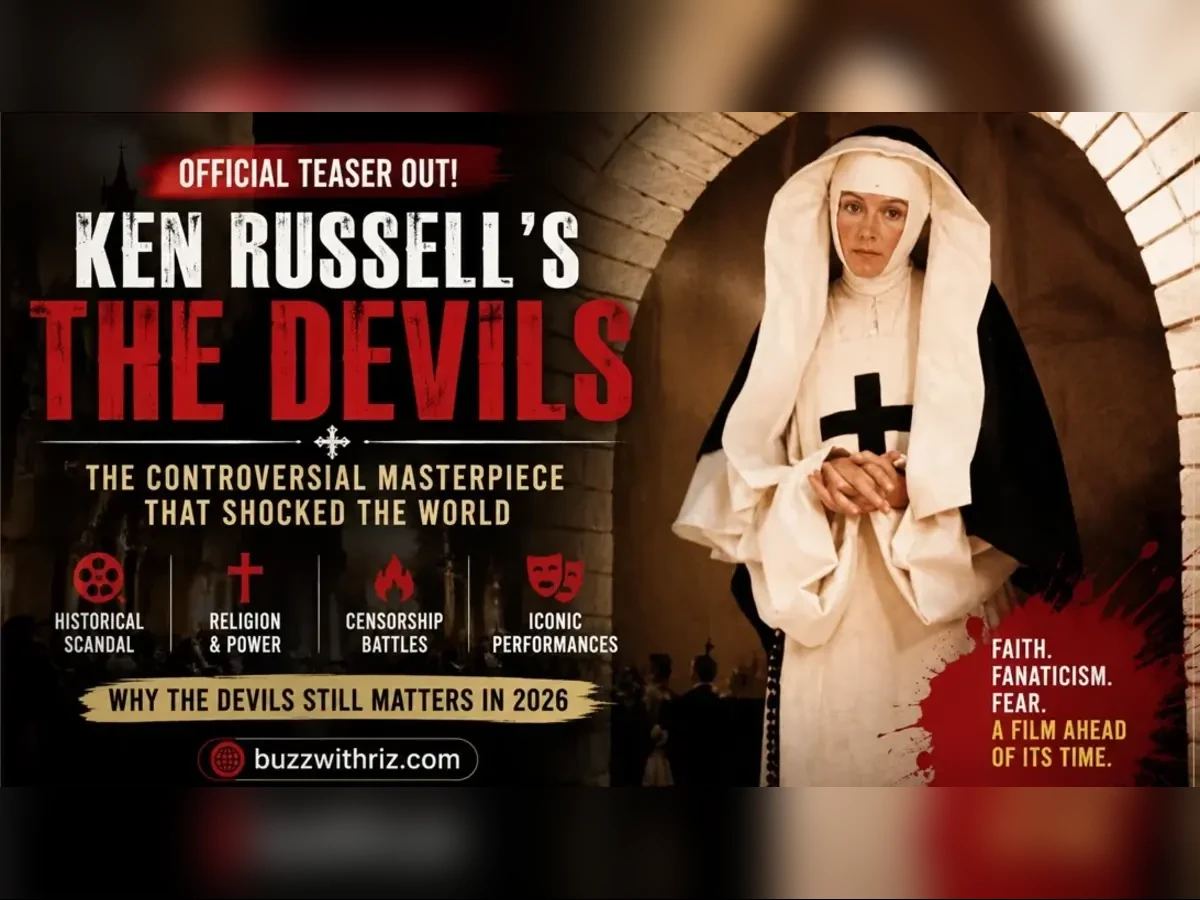
More than five decades after its original release, Ken Russell’s The Devils continues to provoke debate, fascination, and admiration among film scholars, critics, and cinephiles worldwide. The arrival of the official teaser has reignited interest in a film that many consider one of the most daring artistic achievements in British cinema history.
While modern audiences are accustomed to boundary-pushing content, The Devils remains uniquely unsettling because its controversy was never merely about shock value. Beneath its provocative imagery lies a complex exploration of power, faith, hysteria, politics, and institutional corruption.
As renewed conversations emerge around the film’s legacy and preservation, it is worth examining why The Devils remains one of the most discussed and misunderstood works in cinematic history.
The Historical Story Behind The Devils
Released in 1971, The Devils is based on historical events that took place in 17th-century France. The film draws inspiration from Aldous Huxley’s The Devils of Loudun and John Whiting’s stage play The Devils.
The story centers on Father Urbain Grandier, portrayed by Oliver Reed, a charismatic priest accused of witchcraft amidst political intrigue and religious paranoia. Opposing him are powerful forces determined to consolidate authority by manipulating public fear.
Rather than presenting a conventional horror narrative, Russell transforms historical events into an examination of how institutions exploit mass hysteria for political gain.
This historical foundation gives the film remarkable depth. Even decades later, its themes continue to resonate in discussions about media influence, public manipulation, and ideological extremism.
The Official Teaser and Renewed Global Interest
The release of the official teaser has introduced The Devils to a new generation of viewers while reminding longtime fans of its extraordinary visual power.
The teaser emphasizes several defining characteristics:
- Monumental production design
- Stark religious symbolism
- Psychological intensity
- Political subtext
- Visually striking cinematography
Rather than relying on nostalgia, the teaser highlights the film’s continued relevance. Its imagery feels surprisingly contemporary, demonstrating why Russell’s artistic vision remains influential among filmmakers today.
Film enthusiasts across social media platforms, film festivals, and restoration communities have renewed calls for broader access to the film in its most complete form.
Ken Russell’s Vision: Art Beyond Convention
Few directors embraced cinematic excess as fearlessly as Ken Russell.
Throughout his career, Russell challenged traditional filmmaking conventions by combining theatrical spectacle with psychological complexity. His work often explored religion, sexuality, power, and artistic obsession.
With The Devils, Russell pushed these themes further than ever before.
The film’s visual language is intentionally confrontational. Every frame is meticulously designed to create emotional discomfort while forcing audiences to question established systems of authority.
What makes Russell’s approach remarkable is that beneath the spectacle lies rigorous intellectual intent. The film is not controversial merely because of explicit content; it is controversial because it challenges audiences to examine uncomfortable truths about institutions and collective behavior.
Oliver Reed’s Career-Defining Performance
Any discussion of The Devils must acknowledge Oliver Reed’s extraordinary performance.
As Father Grandier, Reed delivers a portrayal filled with contradictions:
- Charismatic yet flawed
- Spiritual yet human
- Courageous yet vulnerable
- Defiant yet tragic
His performance anchors the film emotionally, preventing it from becoming overwhelmed by its visual intensity.
Many critics regard Grandier as one of the greatest characters in British cinema, and Reed’s work remains a benchmark for historical drama performances.
The emotional weight he brings to the story ensures that the film remains deeply human despite its larger-than-life presentation.
Vanessa Redgrave’s Haunting Contribution
Vanessa Redgrave’s portrayal of Sister Jeanne remains one of the most memorable performances in cinema history.
Her character exists at the intersection of religious devotion, psychological suffering, repression, and obsession.
Redgrave avoids simplistic characterization. Instead, she creates a figure who evokes both sympathy and unease.
The teaser image alone demonstrates why her performance continues to be studied in film schools worldwide. Every expression communicates layers of emotional complexity that enrich the film’s exploration of desire, faith, and manipulation.
Why The Devils Became So Controversial
The controversy surrounding The Devils stems from multiple factors rather than any single scene.
Religious Themes
The film directly engages with religious institutions, challenging authority and exposing corruption within powerful structures.
Political Commentary
Russell uses historical events to critique centralized power and political opportunism.
Graphic Imagery
The film contains disturbing sequences intended to illustrate mass hysteria rather than provide sensational entertainment.
Censorship Battles
For decades, various versions of the film have been edited, restricted, or withheld from wider audiences due to concerns about controversial content.
These factors combined to create one of the most infamous censorship disputes in cinema history.
The Importance of Film Preservation
One of the most significant conversations surrounding The Devils today concerns preservation and restoration.
Film historians argue that culturally significant works should be preserved in forms that accurately reflect their creators’ intentions.
The ongoing debate surrounding The Devils raises important questions:
- Who decides what audiences can see?
- Should controversial art be altered?
- How should historical works be preserved?
- What role do archives play in protecting cultural heritage?
These discussions extend far beyond a single film and affect cinema preservation worldwide.
Influence on Modern Filmmaking
The impact of The Devils can be seen across multiple genres.
Its influence appears in:
Psychological Horror
Modern horror filmmakers increasingly focus on psychological tension and societal fear rather than simple jump scares.
Historical Horror
The blending of real historical events with horror elements has become increasingly popular.
Arthouse Cinema
Russell’s willingness to combine experimental visuals with mainstream storytelling continues to inspire directors around the world.
Religious Horror
Many contemporary films exploring faith and fanaticism owe a creative debt to The Devils.
Its legacy extends far beyond British cinema, influencing filmmakers across Europe, North America, and Asia.
Why the Film Matters in 2026
In many ways, The Devils feels more relevant today than when it first appeared.
Modern societies continue to grapple with:
- Misinformation
- Public hysteria
- Political polarization
- Institutional accountability
- Conflicts between individual freedom and collective power
The film’s central themes resonate because they address timeless human behaviors.
What once appeared controversial for purely religious reasons is now increasingly appreciated for its broader social and political insights.
Critical Reassessment and Modern Legacy
Over the years, critical opinion has shifted dramatically.
While some early reviews focused primarily on the film’s provocative content, contemporary scholars often emphasize:
- Its artistic ambition
- Historical significance
- Visual innovation
- Political commentary
- Exceptional performances
Today, many critics regard The Devils as a landmark achievement in British filmmaking.
Its reputation has evolved from scandalous curiosity to essential cinema.
This reassessment reflects broader changes in how audiences engage with challenging works of art.
Final Thoughts
The official teaser serves as more than a promotional piece it is a reminder of cinema’s ability to challenge, provoke, and endure.
Ken Russell’s The Devils remains one of the most ambitious films ever created, not because it sought controversy, but because it dared to confront complex issues that many artists avoided.
Its exploration of power, faith, fear, and manipulation remains startlingly relevant. As new audiences discover the film and longtime admirers revisit it, The Devils continues to prove that great cinema transcends generations.
More than fifty years after its debut, it remains a powerful testament to artistic courage and the enduring importance of preserving challenging works of cultural significance.
SOURCE: Warner Bros, British Film Institute (BFI), IMDB, JSTOR Digital Library, Deadline
Keep in Touch For More Updates: www.buzzwithriz.com
Table of contents
- The Historical Story Behind The Devils
- The Official Teaser and Renewed Global Interest
- Ken Russell’s Vision: Art Beyond Convention
- Oliver Reed’s Career-Defining Performance
- Vanessa Redgrave’s Haunting Contribution
- Why The Devils Became So Controversial
- Religious Themes
- Political Commentary
- Graphic Imagery
- Censorship Battles
- The Importance of Film Preservation
- Influence on Modern Filmmaking
- Psychological Horror
- Historical Horror
- Arthouse Cinema
- Religious Horror
- Why the Film Matters in 2026
- Critical Reassessment and Modern Legacy
- Final Thoughts

1 Comment
Pingback: Sense and Sensibility (2026) Trailer Review and Analysis