





When Fallout premiered on Prime Video, it exceeded even the most optimistic expectations. Adaptations of beloved video games often struggle to balance fan loyalty with mainstream appeal, yet Fallout managed something rare: it respected decades of lore while welcoming viewers who had never touched a controller.
Now, with Fallout Season Two officially teasing New Vegas, the series is stepping into sacred territory.
New Vegas is not just another location. For long-time fans, it represents the philosophical heart of the franchise, where morality, power, and survival collide in complex, uncomfortable ways. For Prime Video, this move signals confidence, ambition, and a willingness to engage deeply with Fallout’s most intellectually rich chapter.
This article offers an expert-level, lore-aware, and industry-informed analysis of what Season Two’s New Vegas setting means, why it matters, and how it could redefine video game adaptations on television.
Why New Vegas Matters in the Fallout Universe
A Location That Defined a Generation
Released in 2010 by Obsidian Entertainment, Fallout: New Vegas is widely regarded as the most narratively ambitious entry in the franchise. Unlike earlier titles that focused primarily on survival and exploration, New Vegas leaned heavily into:
- Political factions and ideological conflict
- Moral ambiguity without clear heroes
- Player-driven consequences
- Philosophical questions about governance after collapse
By choosing New Vegas, Prime Video is not chasing nostalgia. It is embracing complexity.
Fallout Season Two: What We Know So Far
While Prime Video has been deliberately cautious with spoilers, the New Vegas featurette confirms several key elements:
- The Mojave Wasteland will be central to the narrative
- Iconic visual elements from the game are being faithfully adapted
- The tone shifts toward political tension and factional struggle
- Returning characters intersect with new power centers
This approach mirrors Season One’s success: honoring source material without retelling game plots verbatim.
Visual Storytelling: The Power of the Image
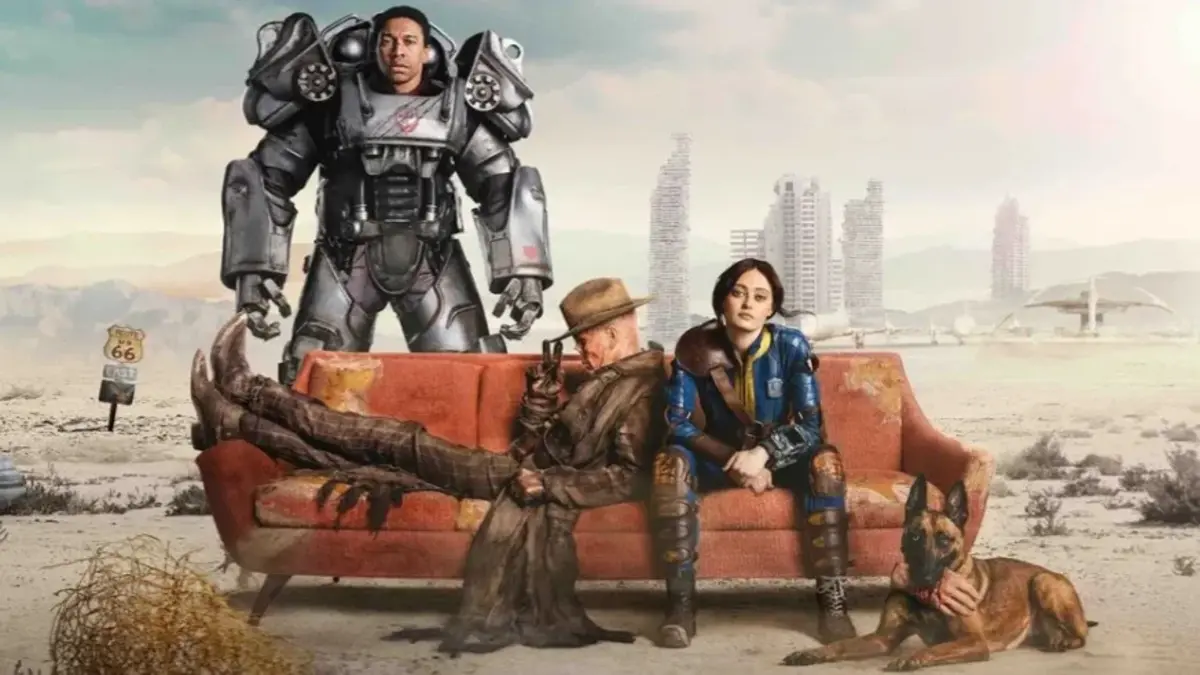
The promotional image accompanying the New Vegas reveal speaks volumes without a single line of dialogue.
We see:
- A desolate desert landscape reminiscent of the Mojave
- A retro-futuristic couch symbolizing the remnants of pre-war comfort
- Armored authority looming behind weary survivors
- A German Shepherd evoking loyalty, survival, and companionship
This is classic Fallout storytelling: absurdity layered over existential dread.
Character Dynamics: Strength, Survival, and Authority
Power Armor as a Symbol, Not a Costume
In Fallout, power armor is never just armor. It represents:
- Institutional control
- Militarized order
- The illusion of safety
Season Two appears poised to explore how such symbols operate in a fractured society, especially within New Vegas’ faction-driven environment.

Civilian Survivors Take Center Stage
One of Season One’s greatest strengths was its focus on ordinary people navigating extraordinary circumstances. That appears to continue here, grounding New Vegas’ political drama in human stakes rather than spectacle alone.
Thematic Evolution in Season Two
From Survival to Governance
Season One asked: How do people survive after the end of the world?
Season Two asks: Who gets to rule what’s left?
New Vegas is uniquely suited to explore:
- The ethics of leadership
- The cost of order versus freedom
- Whether rebuilding civilization repeats old mistakes
These are not simple action-adventure themes. They are deeply human questions.
Why Prime Video Is Betting Big on Fallout
From an industry perspective, Fallout represents a rare opportunity:
- A globally recognized IP
- A multigenerational fanbase
- A universe flexible enough for long-form storytelling
By expanding into New Vegas, Prime Video positions Fallout not as a novelty adaptation, but as a prestige science fiction series capable of standing alongside The Expanse or Westworld.
Fidelity Without Fan Service
One of the smartest choices the creators continue to make is restraint.
Instead of recreating game quests or iconic characters beat-for-beat, the series:
- Builds parallel narratives
- Uses familiar locations as thematic anchors
- Respects lore without being trapped by it
This is precisely how adaptations earn trust
Source: Prime Video, YouTube, IMDB
Keep in Touch For More Updates: www.buzzwithriz.com


1 Comment
Pingback: Berlin and the Lady with an Ermine: Netflix Date Announcement - buzzwithriz.com