

Explore the Avengers: Doomsday trailer, December 18 release date, cast rumors, Marvel’s multiverse stakes, and what the official footage may reveal.
The Avengers are heading toward another world-shaking conflict, and the title Avengers: Doomsday immediately signals that Marvel Studios is aiming for something far more consequential than a conventional superhero sequel.
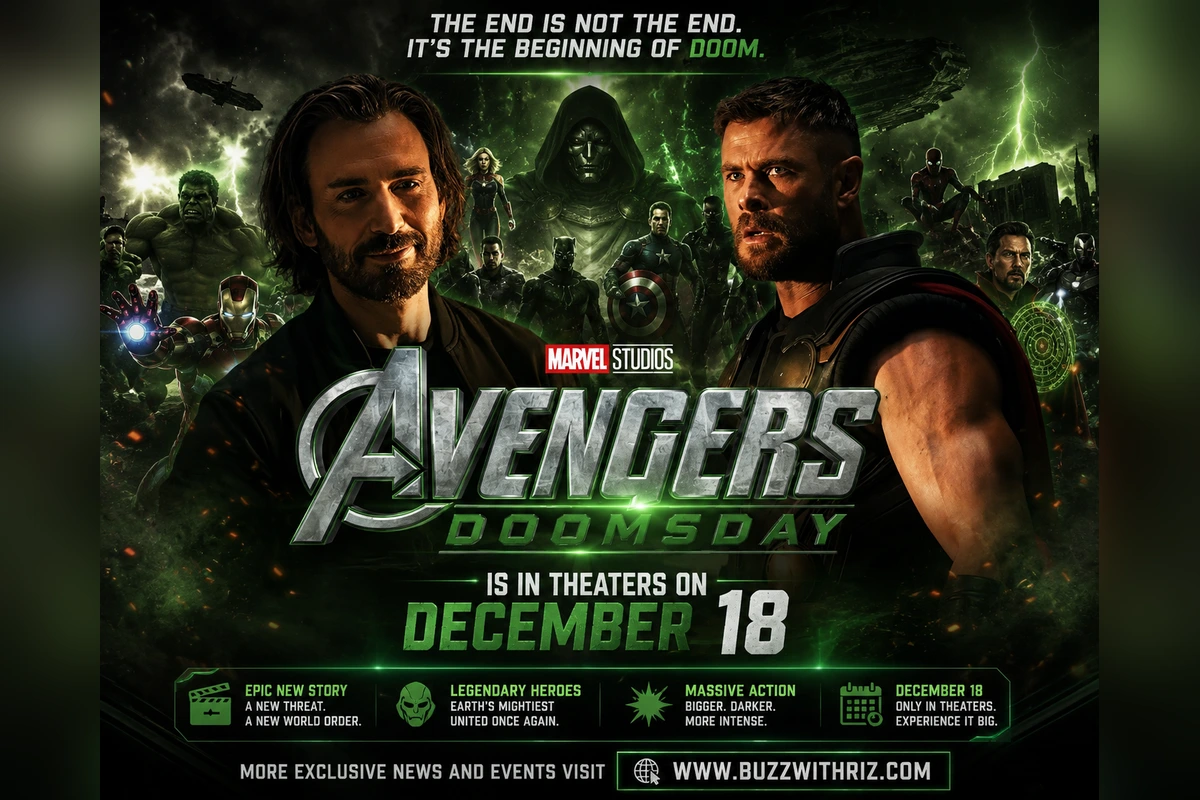
The official promotional image presents a stark, industrial visual identity: the familiar Avengers emblem appears battered, metallic and surrounded by a dark green atmosphere. Beneath it, the word “Doomsday” dominates the frame. The design is deliberately ominous. This is not the bright, triumphant branding associated with the early Avengers era. It suggests a team facing collapse, a civilization approaching catastrophe, or a threat powerful enough to redefine the Marvel Cinematic Universe.
Marvel Studios has confirmed the film for a December 18 theatrical release, making it one of the studio’s major event movies. For audiences who have followed the MCU from Iron Man through the Multiverse Saga, the next Avengers film represents more than another chapter. It is a potential collision point for multiple heroes, timelines, realities and long-running storylines.
What Does the Avengers: Doomsday Title Tell Us?
Marvel has always used titles strategically. Infinity War promised a conflict over the Infinity Stones. Endgame suggested the final stage of an enormous story. Doomsday is equally direct.
The word carries an immediate sense of finality. It implies an event that threatens everything at once. In comic-book storytelling, “doomsday” can mean the destruction of a world, the collapse of a reality, or the arrival of a villain whose ambitions extend beyond ordinary conquest.
That makes the title especially interesting within the MCU’s broader multiverse storyline.
The Marvel Cinematic Universe has increasingly expanded beyond a single timeline. Films and series have explored alternate realities, branching universes, time travel and characters who exist in different versions across the multiverse. A movie called Avengers: Doomsday naturally raises the possibility that the threat will not be limited to one city, one planet or even one universe.
However, it is important to distinguish between confirmed information and speculation. The title establishes the scale and tone of the film. It does not, by itself, confirm a specific plot, villain or storyline.
The Official Trailer Image Sets a Darker Tone
The image associated with the official trailer is visually significant.
The Avengers logo is presented in a heavy metallic style, surrounded by deep shadows and a green-lit environment. The result feels closer to a warning than a celebration. The familiar emblem remains recognizable, but the atmosphere around it is hostile and mysterious.
That visual language immediately invites questions:
- Is the Avengers team operating from a damaged headquarters?
- Does the green atmosphere connect to a particular character or storyline?
- Is the image representing a specific location, or simply the film’s overall aesthetic?
- Does the battered appearance of the logo symbolize the state of the team?
At this stage, the image should be read primarily as a branding and tone-setting asset. It is not proof of a particular plot detail.
Still, Marvel marketing rarely chooses its visual identity at random. The contrast between the iconic silver Avengers lettering and the dark green background creates a sense of tension. The logo remains powerful, but the world around it appears unstable.
That is a fitting visual metaphor for the current MCU.
Why Avengers: Doomsday Could Be a Major MCU Turning Point
The first Avengers movie brought together heroes who had previously appeared in separate films. Infinity War expanded that idea into a massive crossover. Endgame transformed the crossover movie into a global cultural event.
The challenge for Avengers: Doomsday is therefore enormous.
The film has to accomplish several things at once. It must work as a standalone blockbuster, continue the ongoing Marvel storyline, give major characters meaningful moments and satisfy audiences who have invested years in the franchise.
That is a difficult balancing act.
The strongest Avengers movies have understood that spectacle alone is not enough. The battles matter because the audience cares about the people involved. The destruction of a fictional world only carries emotional weight when the characters and consequences feel real.
For that reason, the most important question may not be simply “Who is in Avengers: Doomsday?”
A better question is:
What has changed in the MCU since the last Avengers team stood together?
The franchise has entered a different era. The original Avengers lineup is no longer the same. New heroes have emerged, established characters have evolved, and the boundaries between different Marvel realities have become increasingly important.
A successful Doomsday story could use that uncertainty as its greatest strength.
Avengers: Doomsday and the Future of the Multiverse Saga
The multiverse has become one of the defining concepts of modern Marvel storytelling.
It offers enormous creative possibilities. Different versions of familiar heroes can exist. Characters from separate franchises can potentially meet. Events can have consequences across multiple realities rather than only one timeline.
But the multiverse also creates a storytelling challenge: too many possibilities can make a story feel weightless.
If every character can be replaced by another version, audiences may begin to wonder whether anything is permanent. The most effective multiverse stories therefore need clear emotional stakes.
That is where an Avengers film can become particularly important.
The Avengers are traditionally defined by unity. They are individuals from different backgrounds who must work together against a threat too large for one hero to defeat alone. A multiverse crisis takes that concept to an even larger scale.
Instead of bringing together different heroes, the story could potentially explore the collision of different realities, histories and versions of the Marvel universe.
Whether Avengers: Doomsday takes that approach remains to be seen. The official title and marketing establish a massive threat, but audiences should wait for confirmed information before treating online theories as fact.
What Could the December 18 Release Mean for the Movie?
A December theatrical release places Avengers: Doomsday in the traditional blockbuster season.
Holiday releases can give major films a powerful advantage. Families are often looking for major entertainment, cinemas attract large audiences during the holiday period, and event movies can remain in theaters for an extended period.
For Marvel Studios, the timing also reinforces the idea that this is intended to be a major cinematic occasion.
The phrase “In Theaters December 18” is important because it emphasizes the theatrical experience. A film of this scale is designed to be experienced on the big screen, with large-scale action, visual effects and an audience reacting together.
That communal element has always been part of the Avengers phenomenon.
The first Avengers film became a landmark because audiences did not simply watch a superhero movie. They watched characters from different stories finally share the same screen. Later films expanded that experience to an unprecedented level.
Doomsday will face the challenge of creating that same feeling for a new generation.
The Biggest Questions Fans Are Asking
Who will lead the new Avengers team?
The MCU has entered a period of transition. The question of leadership is therefore central to the next Avengers movie.
The franchise has introduced multiple characters capable of carrying a major storyline, but leadership is not only about power. The strongest Avengers leader usually provides a sense of direction when the group is divided.
The film’s emotional center could be just as important as its strongest fighter.
What kind of threat is “Doomsday”?
The title suggests a catastrophic event, but the exact nature of that catastrophe remains a key mystery.
Is the threat physical? Cosmic? Temporal? Multiversal?
Marvel has built a universe capable of supporting all three possibilities.
How large will the cast be?
The phrase “Avengers” immediately creates expectations of a crossover. However, the film will need to avoid becoming a simple parade of cameos.
The best ensemble films give each important character a purpose. A large cast can create excitement, but meaningful relationships create lasting impact.
Is Avengers: Doomsday connected to the next major Marvel event?
Fans are naturally looking at the wider MCU timeline and asking how this film fits into Marvel’s future.
The safest approach is to rely on official Marvel Studios announcements rather than unverified social media reports or anonymous “leaks.” The film’s confirmed marketing materials will ultimately provide the clearest roadmap.
The Real Question: Can Marvel Make the Avengers Feel Special Again?
The superhero genre has changed dramatically since the first Avengers film.
Audiences have now seen enormous crossover events, alternate realities and characters from multiple franchises sharing the screen. The novelty of a large cast is no longer enough.
That means Avengers: Doomsday must offer something more.
The film needs a compelling story, memorable character relationships and consequences that feel meaningful. The title promises a crisis of enormous scale, but the emotional power of the movie will depend on how that crisis affects individual characters.
The most successful Marvel stories understand that audiences do not connect with explosions. They connect with choices.
A hero deciding to sacrifice something matters.
A team choosing to trust one another matters.
A character confronting the consequences of a previous decision matters.
If Avengers: Doomsday can combine that emotional foundation with the scale expected from a modern Marvel event film, it has the potential to become a defining chapter in the MCU.
Final Verdict: Avengers: Doomsday Is Already One of Marvel’s Biggest Events
Based on the official title, promotional artwork and confirmed theatrical release information, Avengers: Doomsday is clearly being positioned as a major Marvel Studios event.
The dark visual style immediately separates it from the more triumphant presentation of earlier Avengers films. The title suggests a crisis of historic proportions, while the December 18 theatrical release places the movie firmly in blockbuster territory.
The biggest mysteries remain unanswered: the complete cast, the central conflict, the precise connection to the MCU’s broader multiverse storyline and the full meaning behind the title.
For now, the most reliable conclusion is also the simplest:
The Avengers are returning, and this time, the future of the Marvel universe may be at stake.
As more official information emerges, the trailer will likely become the key to understanding the film’s tone, characters and central conflict. Until then, fans should enjoy the theories—but keep confirmed facts and speculation clearly separated.
One thing is certain: when Avengers: Doomsday arrives in theaters on December 18, Marvel will be asking audiences to once again gather for a cinematic event built on scale, legacy and the impossible challenge of saving the universe.
Source : Marvel, imdb, wikipedia
Keep in Touch For More Updates: www.buzzwithriz.com

3 Comments
Pingback: Aslı Tandoğan & Burak Hakkı Reunite in Mahi: Kara Fatma Movie
Pingback: Avengers: Doomsday – Doctor Doom, Trailer & Release Date
Pingback: Avengers: Endgame Encore Returns to Cinemas September 25