

Some trailers reveal an entire story within a few minutes. Others deliberately hold back, offering just enough visual and emotional clues to leave audiences searching for answers. The official trailer for Big Baby (2026) clearly belongs to the second category.
Rather than relying on fast-paced action or revealing major plot details, the trailer builds anticipation through atmosphere. Every carefully framed shot appears designed to create curiosity rather than provide straightforward explanations. From muted lighting to expressive costume choices and restrained performances, the preview suggests a film that values mood and psychological tension over spectacle.
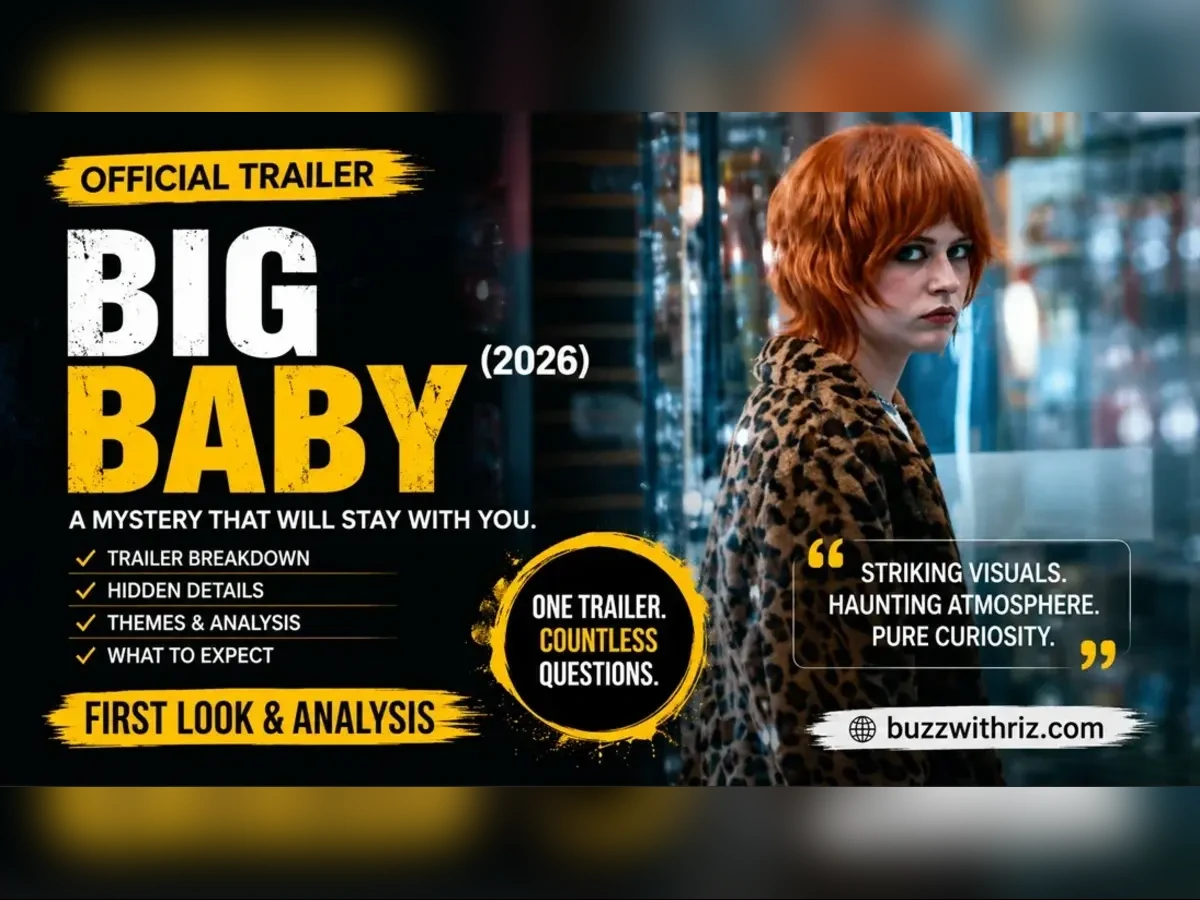
One image in particular immediately captures attention a solitary figure with vibrant orange hair standing quietly inside what appears to be a convenience store. The expression is unreadable, almost confrontational, while the surrounding fluorescent lighting creates an emotional distance that feels intentional. Instead of answering questions, the moment raises dozens of them.
That sense of uncertainty is ultimately the trailer’s greatest strength.
Instead of encouraging viewers to predict the narrative, Big Baby (2026) appears interested in making audiences experience its emotional landscape before they understand its story. In an era where many trailers reveal too much, this restrained approach feels refreshingly confident.
A Trailer Built Around Atmosphere Rather Than Explanation
One of the most noticeable aspects of the trailer is its commitment to visual storytelling.
Dialogue appears limited, allowing facial expressions, camera movement, and carefully designed environments to communicate emotion. This filmmaking technique trusts viewers to interpret scenes rather than relying on exposition.
The pacing also deserves recognition.
Instead of rapid editing that overwhelms the audience, the trailer allows individual shots to breathe. Each scene lingers long enough for viewers to absorb subtle details hidden within the production design.
This slower rhythm creates suspense without needing dramatic action sequences.
Rather than asking,
“What happens next?”
the trailer encourages viewers to ask,
“What exactly am I looking at?”
That distinction may seem subtle, but it completely changes how audiences engage with the preview.
Visual Identity Immediately Sets the Film Apart
Modern cinema is increasingly driven by recognizable visual identities, and Big Baby (2026) appears to understand this principle exceptionally well.
Even with minimal context, several stylistic choices become immediately recognizable.
These include:
- Rich color contrasts
- Carefully controlled lighting
- Symmetrical compositions
- Wide environmental framing
- Deliberate costume design
- Emotionally restrained performances
Together, these elements create a cinematic language that feels intentional rather than decorative.
The convenience store setting shown in the promotional image illustrates this perfectly.
Although convenience stores are ordinary locations, the framing transforms an everyday environment into something quietly unsettling. Bright commercial lighting contrasts sharply with the character’s isolated posture, creating emotional tension from an otherwise familiar space.
This type of environmental storytelling often appears in psychological dramas and character-driven thrillers, where location becomes an extension of the protagonist’s emotional state.
Color Psychology Plays an Important Role
Color has always been one of cinema’s most effective storytelling tools.
Without revealing plot details, the trailer uses contrasting colors to influence emotional perception.
The orange hair immediately becomes the visual focal point.
Against cooler backgrounds filled with glass reflections, muted interiors, and artificial lighting, the warm color creates instant separation between the character and their surroundings.
This visual isolation suggests that the character may not fully belong within the environment they’re occupying.
Meanwhile, the leopard-print coat introduces another layer of symbolism.
Whether interpreted as confidence, rebellion, individuality, or emotional unpredictability, the wardrobe choice makes the character impossible to overlook.
Costume design in contemporary filmmaking often functions as silent storytelling.
Rather than explaining personality through dialogue, filmmakers allow clothing, posture, and movement to communicate emotional complexity.
If the trailer is any indication, Big Baby (2026) appears committed to this philosophy.
Cinematography That Encourages Observation
One reason the trailer feels memorable is its camera work.
Instead of chasing constant movement, the cinematography frequently pauses.
These moments invite audiences to notice reflections, negative space, lighting changes, and facial expressions that might otherwise pass unnoticed.
This observational style often rewards repeat viewing.
Many viewers will likely discover additional visual details after multiple watches, increasing discussion across online communities and social platforms.
Strong cinematography rarely exists purely for aesthetic reasons.
Instead, every composition contributes to emotional storytelling.
The trailer repeatedly demonstrates this balance between artistic ambition and narrative purpose.
Emotional Ambiguity Creates Curiosity
Perhaps the trailer’s greatest achievement lies in what it chooses not to reveal.
There is no obvious hero.
No obvious villain.
No conventional emotional roadmap.
Instead, viewers are presented with fragmented moments that gradually build an atmosphere of uncertainty.
That ambiguity becomes surprisingly compelling.
Rather than manipulating audiences toward predetermined emotional reactions, the trailer encourages personal interpretation.
Every viewer may walk away with a slightly different understanding of what they’ve seen.
This kind of engagement often generates stronger long-term interest than trailers that reveal every major story beat.
For mystery-driven films especially, preserving uncertainty is frequently the smartest marketing strategy.
Sound Design Supports the Visual Storytelling
Although visuals dominate the trailer, sound design quietly amplifies its emotional impact.
Instead of relying on loud orchestral crescendos, the audio appears carefully restrained.
Moments of silence become just as important as music.
Ambient environmental sounds help establish realism while subtle musical cues maintain psychological tension beneath the surface.
This restrained audio approach complements the trailer’s overall philosophy.
Nothing feels exaggerated.
Everything appears measured.
Every sound seems designed to support emotion rather than overwhelm it.
For viewers who appreciate atmospheric filmmaking, this balance significantly enhances immersion.
Storytelling Through Suggestion Instead of Revelation
One of the trailer’s most compelling qualities is its refusal to overexplain. Rather than revealing major plot points, it relies on implication, allowing viewers to piece together fragments of the narrative through visual cues and emotional moments. This approach respects the audience’s intelligence and builds anticipation without diminishing the eventual viewing experience.
Today’s audiences are increasingly drawn to films that invite interpretation rather than simply delivering information. The Big Baby (2026) trailer embraces this philosophy by presenting scenes that feel interconnected yet intentionally incomplete. Every frame appears to raise new questions instead of providing immediate answers.
This restrained style reflects a growing trend in modern filmmaking, where mystery becomes a storytelling tool rather than a marketing gimmick.
Character Presence Speaks Louder Than Dialogue
The trailer places remarkable emphasis on non-verbal storytelling.
Expressions, body language, and carefully timed glances communicate far more than spoken words. The central figure’s quiet intensity immediately commands attention, suggesting emotional depth without relying on lengthy exposition.
This subtle performance style often proves more memorable because it encourages viewers to project their own interpretations onto the character.
Rather than presenting clearly defined motivations, the trailer allows audiences to experience uncertainty alongside the protagonist.
That emotional ambiguity can be particularly effective in psychological dramas and suspense-driven narratives.
Production Design Creates a Living World
Every location glimpsed throughout the trailer appears carefully selected to reinforce the film’s atmosphere.
Instead of functioning merely as backdrops, interiors and public spaces contribute to the emotional tone. Everyday environments are transformed through lighting, framing, and composition into spaces that feel both familiar and unsettling.
The convenience store featured in promotional imagery is a prime example. Bright fluorescent lighting contrasts with the character’s isolated presence, creating visual tension from an otherwise ordinary setting.
Such attention to environmental storytelling suggests a production team focused on immersive world-building rather than spectacle alone.
Editing That Builds Curiosity
Trailer editing is an art in itself, and Big Baby (2026) demonstrates a measured approach.
Rather than relying on rapid-fire cuts designed to overwhelm viewers, the editing allows important moments to linger. This slower rhythm gives audiences time to absorb visual details while maintaining a steady sense of anticipation.
Transitions between scenes feel purposeful, gradually increasing emotional intensity without revealing the larger narrative.
By withholding key information, the trailer encourages repeat viewings, rewarding audiences who notice subtle visual clues or recurring motifs.
Themes That Appear to Emerge
Although the trailer does not explicitly define its story, several themes seem to emerge through its imagery and tone.
Possible thematic elements include:
- Identity and self-perception
- Emotional isolation
- Human vulnerability
- Social alienation
- Memory and perception
- Personal transformation
- Hidden emotional conflict
These observations are based solely on the trailer’s visual presentation rather than confirmed plot details. If these themes continue throughout the finished film, Big Baby (2026) could resonate with audiences seeking thoughtful, character-driven storytelling.
Why the Trailer Stands Out
Many modern trailers prioritize action, revealing significant portions of the plot in an effort to capture attention quickly. In contrast, Big Baby (2026) adopts a more restrained strategy.
Its greatest strengths include:
- Strong visual identity
- Confident pacing
- Atmospheric cinematography
- Intriguing character presentation
- Minimal reliance on exposition
- Emotional subtlety
- High production values
This confidence allows the trailer to leave a lasting impression without sacrificing mystery.
First Impressions
Based solely on the official trailer, Big Baby (2026) appears to prioritize mood, atmosphere, and visual storytelling over conventional blockbuster formulas.
Rather than presenting a straightforward narrative, it encourages audiences to engage with its emotional landscape. The deliberate pacing, striking imagery, and understated performances combine to create a memorable first impression.
Of course, a trailer represents only a small portion of the complete film. Final judgments should always be reserved until the full release, but as a piece of cinematic marketing, this preview succeeds in generating genuine curiosity.
Final Thought
The Big Baby (2026) Official Trailer leaves a strong impression by embracing restraint. Instead of revealing every narrative twist, it invites viewers into a world defined by uncertainty, visual symbolism, and emotional complexity.
Its careful use of cinematography, production design, sound, and performance suggests a film that values atmosphere as much as storytelling. Whether it ultimately fulfills that promise remains to be seen, but the trailer succeeds in generating anticipation through thoughtful craftsmanship rather than spectacle.
For viewers who appreciate psychologically driven cinema and visually expressive filmmaking, Big Baby (2026) is already shaping up to be a title worth following.
SOURCE: Rotten Tomatoes, Letterboxd, IMDB
Keep in Touch For More Updates: www.buzzwithriz.com
