

Some movie trailers rely on explosive action, rapid editing, or dramatic reveals to capture attention. Netflix’s The Debt Collector takes a completely different approach. Instead of overwhelming viewers with spectacle, the official trailer embraces silence, restrained performances, and visually striking compositions that leave audiences asking questions long after it ends.
From its opening moments, the trailer establishes an atmosphere built on tension rather than speed. Every carefully framed shot feels deliberate, inviting viewers to interpret the emotional distance between the characters instead of simply following a sequence of events.
This understated storytelling immediately distinguishes The Debt Collector from many contemporary thrillers. Rather than revealing its secrets too quickly, it encourages curiosity a quality increasingly valued by audiences seeking stories with emotional depth and psychological complexity.
For viewers who appreciate intelligent suspense instead of predictable twists, this first look offers every reason to pay attention.
Netflix Continues Investing in Character-Driven Storytelling
Over the past several years, Netflix has significantly expanded its catalogue of internationally produced films that balance commercial appeal with artistic ambition. Instead of focusing exclusively on Hollywood productions, the streaming platform has increasingly highlighted stories rooted in regional cultures while addressing universal human experiences.
The Debt Collector appears to continue this strategy.
Its trailer suggests a film where personal relationships, moral responsibility, financial hardship, and emotional consequences intersect. Rather than presenting heroes and villains in simple terms, it hints at morally grey characters navigating impossible decisions.
This approach has become one of Netflix’s greatest strengths. Audiences worldwide have shown increasing appreciation for narratives that trust viewers to interpret subtle performances instead of relying on exposition.
A Story Built Around Moral Consequences
Although the official trailer intentionally withholds many plot details, it clearly establishes several central themes.
Debt, in this context, appears to extend far beyond money.
The imagery repeatedly suggests emotional obligations, unresolved guilt, personal sacrifice, and relationships shaped by past decisions. These ideas create a layered narrative where every interaction carries emotional weight.
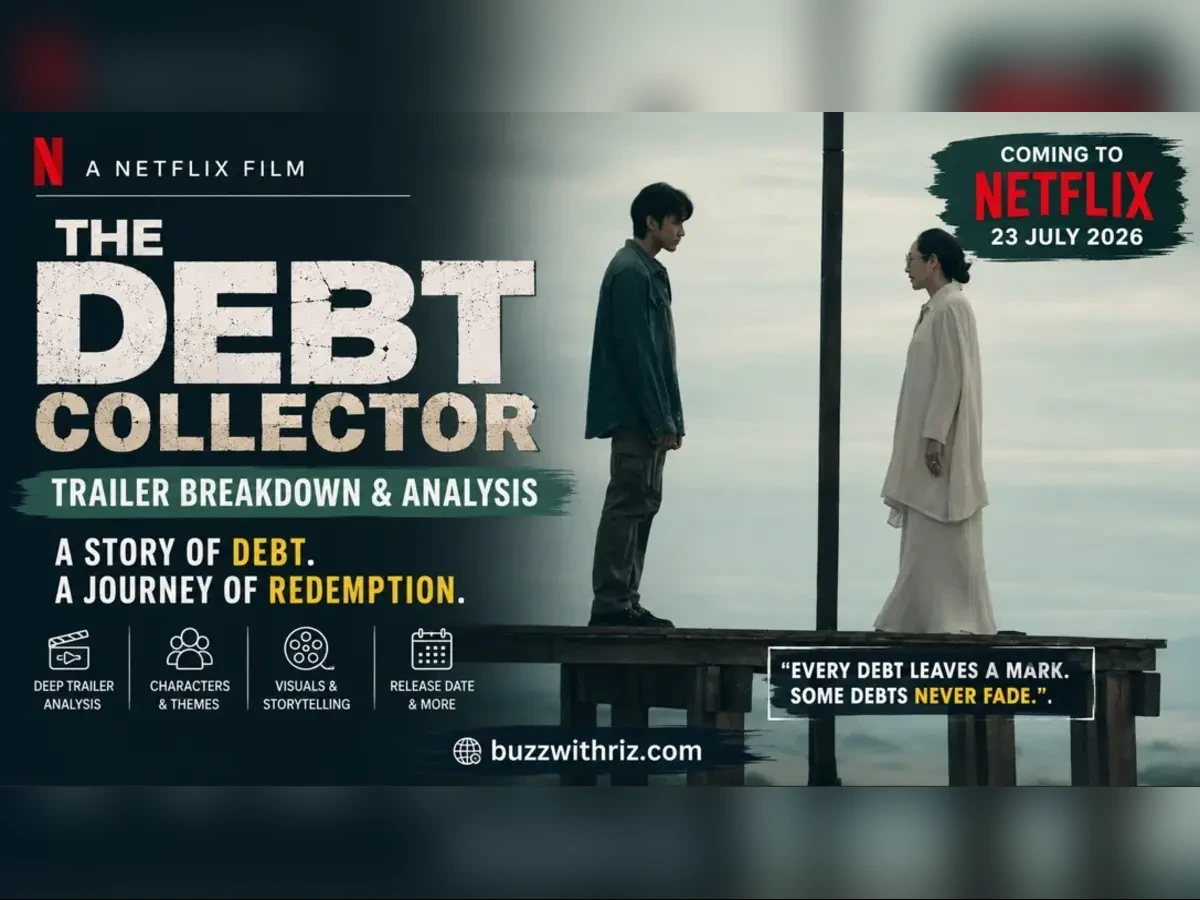
One particularly striking moment features two characters standing opposite each other on an isolated wooden platform. The physical distance between them mirrors an emotional divide, transforming an otherwise simple composition into one of the trailer’s most memorable images.
Rather than explaining their relationship through dialogue, the trailer allows visual storytelling to communicate tension.
That confidence reflects sophisticated filmmaking.
Visual Storytelling Takes Centre Stage
One reason the trailer has attracted attention is its exceptional cinematography.
Muted colour grading creates a restrained visual language dominated by cool blues, soft greys, and natural earth tones. These choices reinforce feelings of isolation, uncertainty, and quiet reflection.
Lighting remains understated throughout the preview.
Instead of dramatic contrasts or exaggerated shadows, natural light shapes each frame with remarkable subtlety. The result feels authentic rather than stylised, allowing emotional performances to remain the primary focus.
Several scenes also employ generous negative space.
Rather than crowding characters into busy environments, the camera often leaves them surrounded by emptiness. This visual isolation reinforces themes of loneliness and emotional burden without requiring explicit explanation.
It is a reminder that great cinematography communicates emotion just as effectively as dialogue.
Why the Trailer Already Feels Different
Today’s streaming landscape is crowded with crime thrillers, psychological dramas, and mystery films competing for attention.
Many rely on familiar marketing formulas:
- Fast editing
- Loud musical cues
- Constant action
- Plot reveals
- Shock moments
The Debt Collector deliberately avoids these conventions.
Instead, its pacing remains calm and deliberate. The editing gives viewers time to absorb each frame, while the restrained soundtrack creates anticipation instead of immediate excitement.
This slower rhythm reflects confidence.
Rather than chasing instant gratification, the filmmakers appear interested in building emotional investment a characteristic often associated with critically acclaimed international cinema.
That creative choice could become one of the film’s greatest strengths.
Themes That Resonate Beyond Crime
Although the title initially suggests a straightforward crime story, the trailer hints at something considerably richer.
Debt is presented not simply as financial liability but as a metaphor for emotional responsibility.
Throughout life, individuals accumulate invisible obligations:
- promises made
- relationships damaged
- sacrifices accepted
- regrets carried
- forgiveness withheld
These emotional debts often shape decisions more powerfully than financial ones.
The trailer appears to explore precisely this idea.
If the completed film expands on these themes with the same subtlety demonstrated in the preview, audiences can expect a story that balances suspense with meaningful emotional reflection.
Performances Built on Restraint
One of the trailer’s most impressive qualities is what its actors choose not to do.
There are no exaggerated emotional breakdowns.
No theatrical confrontations.
No unnecessary displays of anger.
Instead, emotion is communicated through:
- prolonged eye contact
- hesitant body language
- measured movements
- carefully controlled facial expressions
- silence
This restrained acting style allows viewers to project their own interpretations onto each scene.
Rather than instructing audiences how to feel, the performances invite participation.
That collaborative relationship between film and viewer often defines memorable cinema.
The Symbolism Behind the Bridge Scene
The image shown in the official trailer two individuals standing opposite one another on a narrow wooden platform beneath an open sky is arguably its most visually powerful composition.
Rather than placing them in physical conflict, the scene emphasises emotional separation.
The empty space between them becomes symbolic.
It may represent:
- unresolved history
- fractured trust
- emotional distance
- impossible choices
- conflicting responsibilities
The vertical post positioned between the two figures subtly reinforces this separation, acting almost as an invisible barrier that neither appears ready to cross.
Without revealing any narrative details, the scene communicates uncertainty, vulnerability, and emotional tension through composition alone.
It is precisely this kind of visual storytelling that often distinguishes sophisticated psychological dramas from more conventional thrillers.
Why Anticipation Continues to Grow
Audience reactions following the trailer’s release have largely focused on its atmosphere rather than its plot.
That is significant.
Instead of asking, “What happens next?” many viewers are asking, “What does this mean?”
Curiosity driven by interpretation often generates longer-lasting discussion than curiosity driven purely by unanswered plot questions.
Films remembered years later frequently encourage multiple viewings because audiences continue discovering new details.
The trailer for The Debt Collector creates precisely that impression.
Rather than answering questions, it encourages audiences to keep asking them.
Direction That Prioritizes Emotion Over Spectacle
One of the strongest impressions left by The Debt Collector trailer is its confidence in visual storytelling. Rather than relying on explosive action or dramatic twists, the film appears to embrace quiet moments where emotions are conveyed through body language, silence, and carefully framed compositions.
This approach reflects a growing trend in contemporary Asian cinema, where atmosphere and character development often take precedence over fast-paced storytelling. By allowing scenes to unfold naturally, the film creates space for audiences to engage emotionally and interpret the characters’ motivations.
If the finished feature maintains this disciplined style, The Debt Collector could appeal to viewers who appreciate thoughtful thrillers that reward patience and attention.
A Cinematic Style Built on Atmosphere
The trailer’s visual language suggests a film crafted with precision. Wide shots emphasize isolation, while close-ups capture subtle emotional shifts without overstatement. The restrained color palette, soft natural lighting, and uncluttered settings reinforce a mood of uncertainty and introspection.
These artistic choices contribute to a cinematic experience where every frame serves a narrative purpose. Rather than distracting viewers with visual excess, the film appears focused on drawing them into its emotional landscape.
Atmosphere becomes more than an aesthetic choice it becomes an essential part of the storytelling.
Themes That Extend Beyond the Title
Although debt is commonly associated with financial obligation, the trailer strongly implies that the film explores broader and more personal forms of accountability.
Several themes appear central to the story:
Responsibility
The characters seem burdened by obligations that extend beyond money, suggesting that choices made in the past continue to shape their present lives.
Trust
The emotional distance portrayed between key figures hints at fractured relationships where trust has been tested, lost, or perhaps can still be restored.
Redemption
The trailer leaves open the possibility that its characters are seeking forgiveness, understanding, or a second chance rather than simple resolution.
Consequences
Every action appears to carry lasting emotional weight, reinforcing the idea that no decision exists in isolation.
These universal themes help explain why the trailer resonates across cultures. Regardless of background, audiences understand the emotional complexity of responsibility, regret, and reconciliation.
Why This Film Stands Out in Netflix’s 2026 Lineup
Streaming audiences have become increasingly selective. With hundreds of new titles released each year, only a handful generate meaningful conversation beyond their opening weekend.
The Debt Collector has several qualities working in its favor:
- A restrained yet emotionally compelling trailer
- Strong visual storytelling
- Themes with universal appeal
- Character-driven suspense
- A cinematic style that values subtlety over spectacle
Rather than presenting itself as another conventional thriller, the film appears to invite viewers into a layered psychological drama that encourages reflection long after the credits roll.
That combination often distinguishes memorable films from disposable entertainment.
Final Thought
Based solely on its official trailer, The Debt Collector demonstrates remarkable confidence in its storytelling approach. Instead of revealing major plot points, it establishes mood, introduces emotional tension, and encourages viewers to ask meaningful questions about its characters and themes.
The trailer succeeds because it trusts its audience. It offers enough information to generate intrigue while preserving the mystery that makes psychological thrillers so compelling.
If the complete film delivers on the promise shown in these first images, The Debt Collector could become one of Netflix’s most discussed international releases of 2026, attracting viewers who value thoughtful narratives, nuanced performances, and visually expressive filmmaking.
For fans of character-driven suspense, this is undoubtedly a title worth adding to the watchlist.
SOURCE: Netflix, Rotten Tomatoes, IMDb, TMDb, About Netflix
Keep in Touch For More Updates: www.buzzwithriz.com

2 Comments
Pingback: MARFIL Official Teaser Breakdown | Prime Video
Pingback: Butterfly (2026) Trailer Review