

Turkish TV drama industry 2026 analysis here. Turkey’s 2026 TV season sees 12 returning series amid rising costs, falling ad revenue, and TRT leading with 4 hit dramas continuing strong.
The September 2026 television season will carry forward 12 returning series from the current lineup, with TRT emerging as the most stable and fortunate broadcaster.
The first half of 2025 and 2026 proved to be a difficult period for the television industry. Due to the ongoing economic crisis, advertising revenues declined significantly, at times even affecting the broadcast of new episodes. In certain weeks, reruns were aired because sufficient advertising income could not be secured.
There has also been a sharp decline in the number of newly produced series. Private broadcasters have struggled with payment obligations. Meanwhile, the per-episode production cost of new series has exceeded 30 million TL, while the highest budgets allocated by channels for new productions remain around 24 million TL. This imbalance has contributed to a gradual reduction in the number of new drama projects.
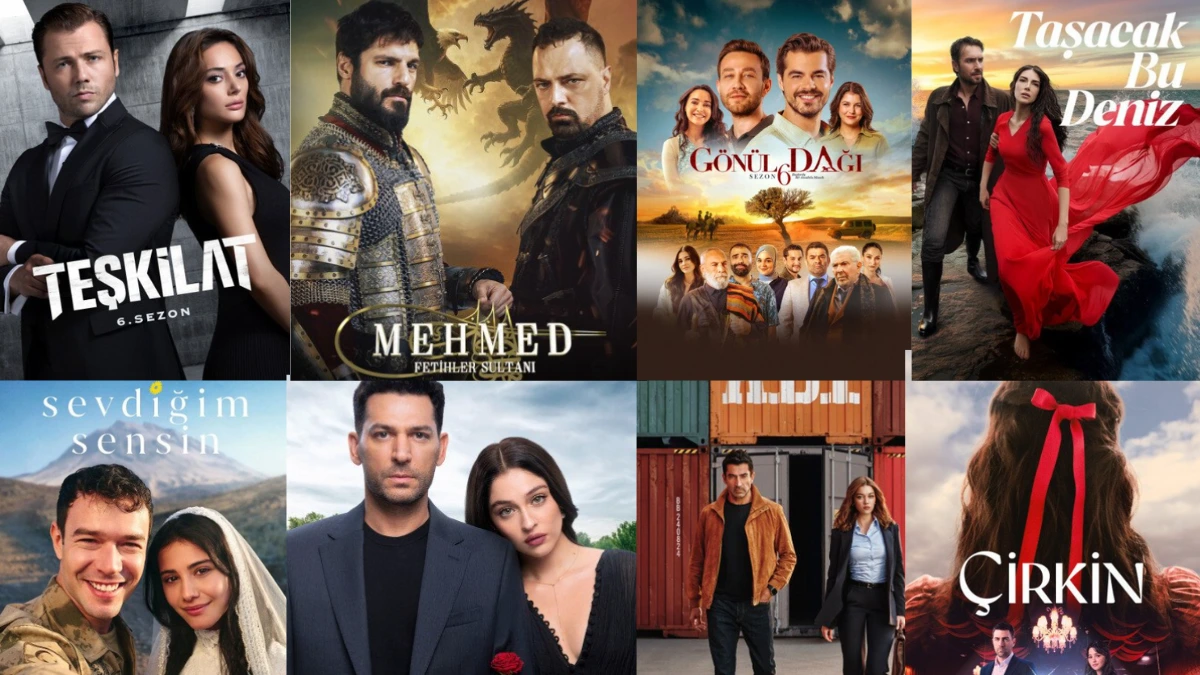
Despite these challenges, 12 series will continue into the new broadcast season. TRT stands out by continuing four of its own successful productions.
Among private channels, ATV will continue A.B.İ., Show TV will continue Kızılcık Şerbeti, Star TV will carry forward Sevdiğim Sensin and Çirkin, NOW will continue Halef and Yeraltı, and Kanal D will continue Uzak Şehir and Güller ve Günahlar.
Kanal D’s long-running series Arka Sokaklar, which is expected to conclude its seasonal run, will have its future determined depending on economic conditions in the upcoming season.
TRT emerges as the strongest and most stable broadcaster, continuing four major productions into the new season: Mehmed: Sultan of Conquests (Season 4), Gönül Dağı (Season 7), Taşacak Bu Deniz (Season 2), and Teşkilat (Season 7).
A Turning Point for Turkish Television Drama in 2026
The Turkish television industry is entering a transitional phase that reflects broader economic pressures and evolving viewer habits. The 2026 September broadcast season is particularly significant, with only 12 existing series being carried forward an unusually tight number for a market historically known for high-volume drama production.
At the center of this shift is a simple but powerful equation: rising production costs versus shrinking advertising revenues. This imbalance is reshaping the entire structure of Turkish scripted television.
Rising Costs, Shrinking Margins
Industry estimates indicate that per-episode production costs have now surpassed 30 million TL for high-end drama series. At the same time, most television networks are unable to allocate budgets beyond the 24 million TL threshold per episode.
This gap is not merely financial it is structural. It directly affects:
- The number of new series commissioned
- The survival rate of mid-season productions
- The reliance on established “safe” titles
- The increase in reruns during low-advertising weeks
In practical terms, this means fewer risks are being taken by broadcasters. Instead, networks are leaning heavily on proven brands and long-running series that guarantee stable ratings.
Advertising Pressure and Broadcast Instability
One of the most visible symptoms of the crisis has been the instability in weekly broadcasting schedules. In some cases, channels have replaced new episodes with reruns due to insufficient advertising revenue.
This is a significant shift for Turkish prime-time television, where consistency is key to maintaining audience loyalty. The uncertainty also impacts international distribution deals, as global buyers prefer stable, uninterrupted airing patterns.
12 Series Carry Over Into the New Season
Despite the challenges, 12 series have managed to secure continuation into the 2026 season. This includes a mix of long-running franchises and newer successful productions.
Private broadcasters have strategically selected their strongest performers:
- ATV continues with A.B.İ.
- Show TV continues with Kızılcık Şerbeti
- Star TV continues with Sevdiğim Sensin and Çirkin
- NOW continues with Halef and Yeraltı
- Kanal D continues with Uzak Şehir and Güller ve Günahlar
Meanwhile, Arka Sokaklar, one of the longest-running Turkish series, remains under evaluation depending on future economic conditions.
TRT’s Strategic Advantage in a Competitive Market
Among all broadcasters, TRT stands out as the most stable player entering the 2026 season. With four continuing series, it demonstrates a rare level of consistency in a volatile market.
TRT’s returning lineup includes:
- Mehmed: Sultan of Conquests (Season 4)
- Gönül Dağı (Season 7)
- Taşacak Bu Deniz (Season 2)
- Teşkilat (Season 7)
This stability is largely attributed to TRT’s public broadcasting structure, which allows for more predictable budgeting compared to ad-dependent private channels.
What This Means for the Future of Turkish Drama
The current trend suggests a future dominated by fewer but stronger productions. Instead of launching dozens of new titles each season, networks are likely to focus on:
- Franchise expansion of successful series
- Higher production value per show
- Longer seasonal runs for proven hits
- Strategic international sales partnerships
Turkey remains one of the world’s most influential drama exporters, but the internal market is clearly undergoing consolidation.
Industry Outlook: A Leaner but Stronger Ecosystem?
While the decline in new productions may appear concerning, some analysts argue that this shift could ultimately improve overall quality. With fewer projects competing for airtime and budgets concentrated on established titles, storytelling may become more refined and production values more consistent.
However, the risk remains that reduced creative experimentation could limit innovation in the long term.
FINAL THOUGHT
The 2026 Turkish television season reflects more than just a programming shift—it signals a structural recalibration of the entire drama industry. With rising production costs pushing beyond sustainable thresholds and advertising revenues failing to keep pace, broadcasters are being forced into a more conservative, survival-oriented strategy.
In this environment, fewer new projects are being greenlit, while proven series are becoming the backbone of scheduling decisions. TRT’s ability to maintain four continuing high-profile dramas highlights the advantage of stable funding models in an increasingly volatile commercial market.
If current conditions persist, the Turkish TV landscape is likely to evolve into a “quality-over-quantity” era—where long-running franchises dominate prime time, and experimental storytelling becomes rarer but potentially more impactful.
Ultimately, the key question for 2027 and beyond is not how many series will be produced, but how many can sustainably survive in a tightening economic framework without losing creative diversity.
SOURCES
- Medyatava
- TRT1
- TIAK official reports
- Reuters Turkey media and economy coverage
- Birsen Altuntaş entertainment news coverage
- Anadolu Agency
Keep in Touch For More Updates: www.buzzwithriz.com
