

The first trailer for Amrum premiered at the Toronto International Film Festival (TIFF) 2026, and it has already sparked serious conversation among critics and cinephiles alike. In an era where spectacle often overshadows substance, Amrum appears to take a different path offering a restrained yet emotionally intense cinematic experience grounded in human resilience, historical nuance, and visual poetry.
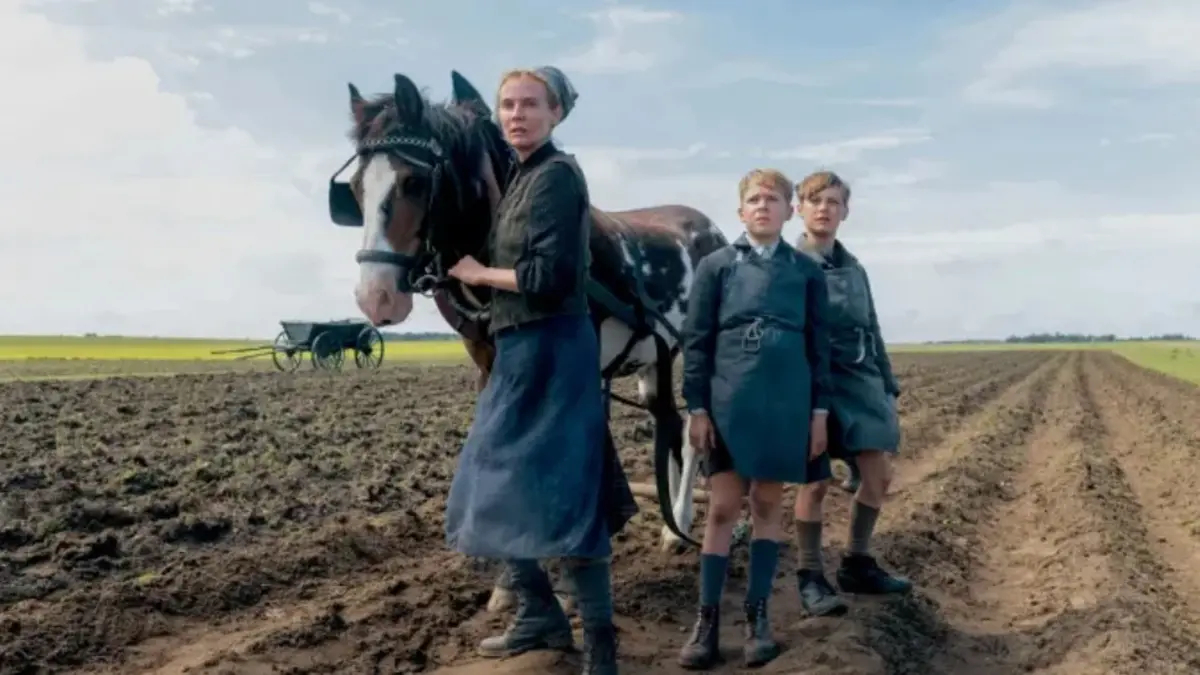
From the opening frame, the film establishes a tone that is both contemplative and unsettling. The imagery of a vast, plowed field, a solitary horse, and a woman standing firm against an unseen tension immediately signals that this is not just a story it’s an atmosphere, a lived experience.
This blog post offers a comprehensive, expert-level analysis of the Amrum trailer, focusing on storytelling, cinematography, thematic depth, and its potential impact in the global film landscape.
Minimalism With Maximum Impact
Unlike many modern trailers that rely heavily on dialogue or rapid editing, Amrum embraces silence and visual storytelling. The pacing is deliberate. Each shot lingers just long enough to create emotional weight without overstaying its welcome.
The composition of the scene particularly the woman holding the horse while two children stand beside her immediately evokes themes of responsibility, survival, and generational tension. There is no overt exposition, yet the viewer instinctively understands that something profound is unfolding.
This approach aligns with high end European arthouse cinema traditions, where less is often more, and emotional depth is conveyed through visual cues rather than explicit narrative.
Painting Emotion Through Landscape
One of the most striking aspects of the trailer is its cinematography. The barren farmland, stretching endlessly into the horizon, becomes more than just a setting it acts as a character in its own right.
The muted color palette dominated by earthy browns, washed-out blues, and soft greys creates a sense of historical authenticity while reinforcing the film’s somber tone. Natural lighting enhances realism, suggesting a commitment to grounded storytelling rather than stylized dramatization.
The framing is particularly noteworthy. The central figure is often positioned slightly off-center, subtly indicating imbalance or internal conflict. Meanwhile, the distant carriage in the background adds depth and context, hinting at a broader world beyond the immediate frame.
This level of visual precision reflects a director deeply invested in the language of cinema.
Themes and Symbolism: Beneath the Surface
At its core, Amrum appears to explore themes of:
- Survival and hardship in rural settings
- Family dynamics under pressure
- The intersection of innocence and responsibility
- Historical trauma and resilience
The horse, for instance, is not just a functional element it symbolizes labor, endurance, and perhaps even the burden carried by the central character. The children, dressed uniformly, suggest discipline or societal expectation, possibly reflecting a rigid cultural or historical context.
The barren land may represent scarcity not just of resources, but of emotional freedom. There is a palpable sense of constraint, as though the characters are bound by forces beyond their control.
Performance Glimpses: Subtle Yet Powerful
Even within the limited runtime of a trailer, the performances stand out. The central figure presumably the protagonist exudes a quiet strength. Her posture, facial expression, and grip on the horse all communicate determination mixed with underlying tension.
The children, meanwhile, offer a contrast. Their expressions are more neutral, almost detached, which could indicate emotional suppression or adaptation to harsh realities.
This subtle acting style suggests that Amrum will rely heavily on nuanced performances rather than dramatic outbursts a hallmark of critically acclaimed cinema.
Historical Context
While the trailer does not explicitly state the time period, the costumes, setting, and overall aesthetic strongly suggest a historical backdrop possibly early 20th century Europe.
This context is crucial. Films set in such periods often explore themes of societal change, war aftermath, or economic struggle. If Amrum follows this trajectory, it could offer a deeply reflective look at how individuals navigate shifting historical landscapes.
The absence of modern elements reinforces immersion, allowing viewers to fully engage with the world being portrayed.
Why Amrum Stands Out in 2026 Cinema
In a cinematic landscape increasingly dominated by franchises and high budget spectacles, Amrum feels refreshingly grounded. It prioritizes:
- Authentic storytelling over visual excess
- Emotional depth over plot complexity
- Atmosphere over action
This positions it as a strong contender for festival awards and critical acclaim. Films that adopt this approach often resonate deeply with audiences seeking meaningful narratives.
Final Thought
Amrum doesn’t try to impress with noise it lingers, quietly demanding attention through its stillness and emotional precision. In just a brief trailer, it signals a film that values atmosphere over spectacle and depth over distraction.
If this early glimpse is any indication, Amrum could become one of those rare cinematic experiences that stays with you long after the credits roll not because it tells you everything, but because it leaves space for you to feel and interpret.
SOURCE: Variety, The Hollywood Reporter, Toronto International Film Festival, IMDB
Keep in Touch For More Updates: www.buzzwithriz.com

1 Comment
Pingback: Widow’s Bay Teaser Breakdown | Apple TV+ Mystery Thriller