

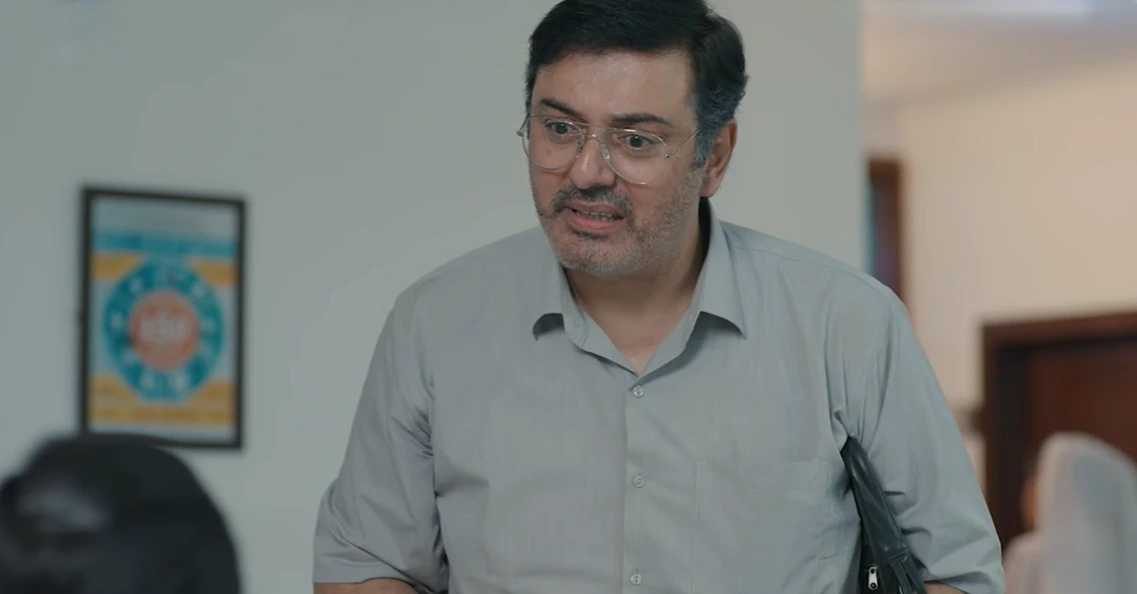
That Exposes the Quiet Violence Behind Polite Faces.
Pakistani television has long excelled at reflecting social realities, but only a few dramas dare to explore the psychological cruelty hidden beneath respectability. Sharpasand is one such narrative—unsettling, introspective, and painfully relevant.
Written by Sara Sadain Syed and directed by Aehsun Talish, Sharpasand does not rely on loud conflicts or melodrama. Instead, it cuts deep with silence, passive aggression, and the kind of emotional wounds that society often refuses to acknowledge. Anchored by Naumaan Ijaz’s chilling performance, the drama questions a dangerous cultural truth: What if the most harmful people are also the most socially admired?
Story Overview
At the center of Sharpasand is Farasat Ali, a man widely regarded as dignified, principled, and respectable. To the outside world, he is the embodiment of moral authority. Inside his home, however, he is someone else entirely.
Farasat possesses a razor-sharp temperament—not explosive, but precise. His words are calculated, his silences punishing, and his emotional control absolute. He does not raise his voice; he diminishes. And that makes him dangerous.
Parallel to Farasat’s story is the journey of Sanam and Fida, a married couple of five years who relocate to a new city seeking stability and renewal. What they encounter instead is a community of Sharpasand people—individuals driven by envy, judgment, and moral superiority. Under the guise of concern and tradition, these people quietly conspire to fracture a marriage built on trust.
As personal insecurities, social manipulation, and unspoken resentments collide, Sharpasand becomes a study of how relationships are not always destroyed by betrayal—but by constant, subtle pressure.
Why the Title “Sharpasand” Matters
The word Sharpasand refers to someone who is excessively critical, fault-finding, and rigid in judgment. This is not accidental.
The drama argues that sharpness of character, when paired with unchecked authority, becomes a weapon. Farasat Ali is not violent in the conventional sense; he is socially sanctioned. His cruelty is justified as discipline, his ego masked as morality.
This makes Sharpasand especially unsettling—because it reflects people we recognize.
Character & Cast Analysis
Naumaan Ijaz as Farasat Ali
Naumaan Ijaz delivers a career-defining performance. Farasat Ali is not a villain you can easily hate. He is calm, composed, and respected—making his emotional abuse even more disturbing.
Ijaz masterfully portrays:
- Narcissistic authority
- Emotional gaslighting
- Moral absolutism
- Silent punishment
This is psychological realism at its finest.
Hareem Farooq as Sanam
Sanam is resilience personified. Hareem Farooq avoids dramatics, opting instead for quiet strength. Her performance reflects countless women who navigate emotional hostility while preserving dignity.
Sanam’s arc highlights:
- Emotional endurance
- Social isolation after marriage
- Internal conflict between self-respect and compromise
Affan Waheed as Fida
Affan Waheed brings warmth and vulnerability to Fida. His character represents men who are emotionally present yet socially pressured.
Fida’s struggle lies in:
- Protecting his marriage
- Navigating toxic social influences
- Redefining masculinity beyond control
Supporting Cast That Elevates the Narrative
- Hira Mani (Shazmeen) – complex, reactive, and layered
- Nadia Afgan (Rubina) – social manipulation disguised as concern
- Ahsan Afzal Khan (Wali) – moral ambiguity
- Saba Bukhari (Minahil) – emotional tension catalyst
Veteran actors like Sabahat Sheikh, Seemi Pasha, and Shahista Jabeen add credibility and generational realism.
Core Themes Explored in Sharpasand
1. Emotional Abuse Without Bruises
The drama highlights how emotional cruelty often goes unnoticed because it leaves no physical evidence.
2. Social Hypocrisy
Community members play judge, jury, and executioner—while pretending to uphold values.
3. Marriage as a Battleground
Sanam and Fida’s relationship shows how external voices can destabilize even healthy bonds.
4. Power Disguised as Morality
Farasat Ali’s authority is rooted in society’s willingness to excuse cruelty when it comes dressed as virtue.
Direction, Writing & Visual Language
Director Aehsun Talish employs restrained visuals—tight frames, long pauses, muted tones—to mirror emotional suffocation. The writing avoids exposition, trusting the audience’s intelligence.
Sara Sadain Syed’s script stands out for:
- Psychological realism
- Layered dialogue
- Absence of moral spoon-feeding
Final Verdict: Why Sharpasand Matters
Sharpasand is not just a drama—it is a mirror. It challenges viewers to recognize cruelty that hides behind politeness and control that masquerades as concern. With stellar performances, intelligent writing, and psychological depth, it stands among the most socially relevant Pakistani dramas of recent years.
This is storytelling that lingers—because it feels uncomfortably real.
Source: Ary digital, Sharpasand official, IMDB
Keep in Touch For More Updates: www.buzzwithriz.com
