

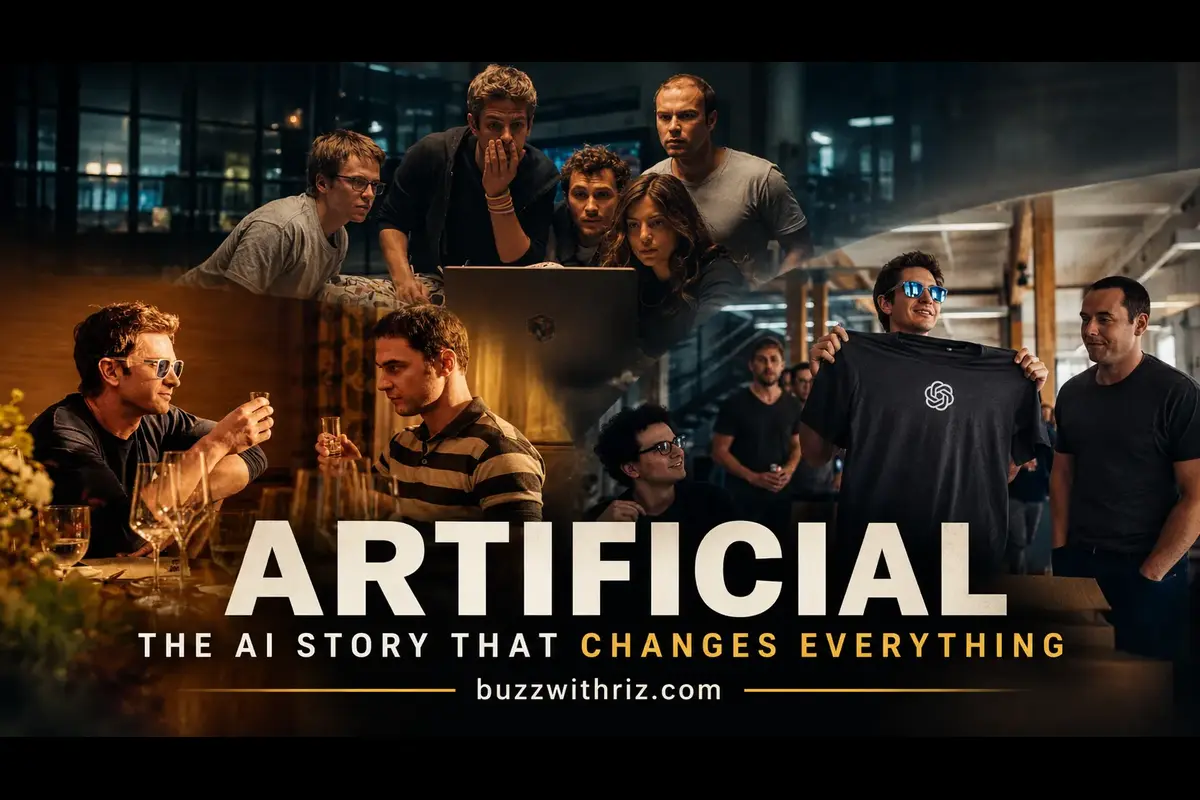
The most unsettling image in the new trailer for Artificial is not a machine, a server room or a futuristic city. Instead, it is a group of people crowded around a laptop, watching the screen with the concentration of people facing a crisis. Ultimately, that image captures the film’s central tension: people may build artificial intelligence in code, but the decisions surrounding it are unmistakably human.
Directed by Luca Guadagnino, Artificial turns the rise of OpenAI into a drama about ambition, loyalty and who gets to shape powerful technology. The official trailer, released by NEON, places Andrew Garfield at the centre as Sam Altman and signals a story as interested in people and power as it is in AI.
What Is Artificial About?
Artificial follows the people and events behind OpenAI’s emergence, drawing on two decades of machine-learning development and the company’s turbulent 2023 leadership crisis. The story brings together computer scientist Ilya Sutskever, entrepreneur Sam Altman and other influential Silicon Valley figures as an ambitious research project grows into a company with global consequences.
NEON’s synopsis describes a race to control technology that could change humanity’s future. Beneath that large premise, however, sits a personal question: what happens when people who believe they are building something beneficial disagree about who should guide it?
Artificial is a dramatization, not a documentary. Therefore, its scenes should be understood as a cinematic interpretation of public events, not a definitive record of private conversations or motives.
Andrew Garfield Leads a High-Profile Cast
Garfield plays Sam Altman, while Yura Borisov portrays Ilya Sutskever. Monica Barbaro appears as Mira Murati, Mark Rylance plays AI pioneer Geoffrey Hinton, and Ike Barinholtz takes the role of Elon Musk. The ensemble also includes Cooper Hoffman, Jason Schwartzman and Chris O’Dowd.
Garfield portrays a contemporary technology executive whose public profile is closely tied to real events. Borisov, in addition, provides another centre of gravity through Sutskever, whose research and role in the 2023 crisis are central to the film’s premise.
Rather than presenting these figures as a parade of celebrity cameos, the film appears to use them to explore competing convictions: research, commercial ambition, public responsibility and institutional control.
What the Artificial Trailer Reveals
The footage moves between intimate conversations, crowded offices and moments of group tension. In one supplied frame, colleagues lean towards a laptop, their expressions suggesting that something on the screen has changed the mood. Another places two men opposite each other at dinner, glasses raised but expressions guarded. A third shows a company gathering around a branded shirt.
The dinner scene feels personal and almost relaxed; in contrast, the office scenes feel collective, watchful and pressured. The trailer suggests that AI’s consequences do not remain inside laboratories or boardrooms. They follow decision-makers into ordinary conversations and relationships.
That human focus could distinguish Artificial from a conventional technology biopic. Guadagnino has a reputation for character-driven filmmaking, and the New York Film Festival describes this project as a fast-moving drama spanning two decades of machine-learning research. The trailer hints at satire and unease, but the finished film will determine how successfully those tones work together.
Why the Story Matters Beyond Silicon Valley
Notably, Artificial arrives while generative AI is changing how people search, work, create and communicate. Questions about safety, transparency, ownership and accountability affect schools, businesses, artists and everyday users.
In fact, its value may lie in making the human stakes easier to discuss. Who is responsible when a system behaves in unexpected ways? Can a mission remain unchanged as an organisation becomes more powerful? And how should the public judge decisions made behind closed doors?
As a result, those questions give Artificial relevance even for viewers who have never followed OpenAI’s internal history.
Release Date: When Can You Watch Artificial?
NEON lists Artificial for a US theatrical opening on December 25, 2026. The official trailer advertises a wider release on January 8, 2027. Release patterns can vary by territory, so international audiences should check local cinema listings and NEON’s official film page for confirmed dates.
The film is directed by Luca Guadagnino and written by Simon Rich. Its reported running time is 140 minutes, making it a substantial feature rather than a quick, issue-driven dramatization.
Final Verdict: A Timely Drama With Big Questions
The Artificial trailer promises more than a behind-the-scenes look at a famous technology company. It sets up a character-driven story about ambition, trust and the responsibilities that come with building tools powerful enough to reshape society. Garfield’s central performance, Borisov’s presence and Guadagnino’s interest in complicated human relationships make the film worth watching.
Still, Artificial needs to make a complicated history understandable without flattening real people into heroes or villains. If it preserves that complexity while delivering a compelling drama, it could become one of the year’s most conversation-starting films.
For now, the trailer offers an intriguing invitation: look beyond the technology and pay attention to the people deciding what comes next.
